
Transportation authorities and commercial paving contractors face tighter project timelines and stricter safety audits than ever before. Road surfaces require clean, durable demarcation to guide vehicles, support automated driving sensors, and protect pedestrian traffic. Investing in professional paint line striping machines ensures that your projects meet international highway and aviation benchmarks without bleeding operating budgets.
For more than two decades, HVBAN has designed and manufactured heavy-duty fluid handling equipment. By engineering reliable airless road marking machinery, HVBAN helps contractors across the globe achieve clean line edges, consistent mil thickness, and minimal downtime on high-traffic sites.
Planning to upgrade your commercial striping fleet or expand municipal contracting capacity this season? Contact our engineering team today for direct wholesale pricing and technical equipment specifications.
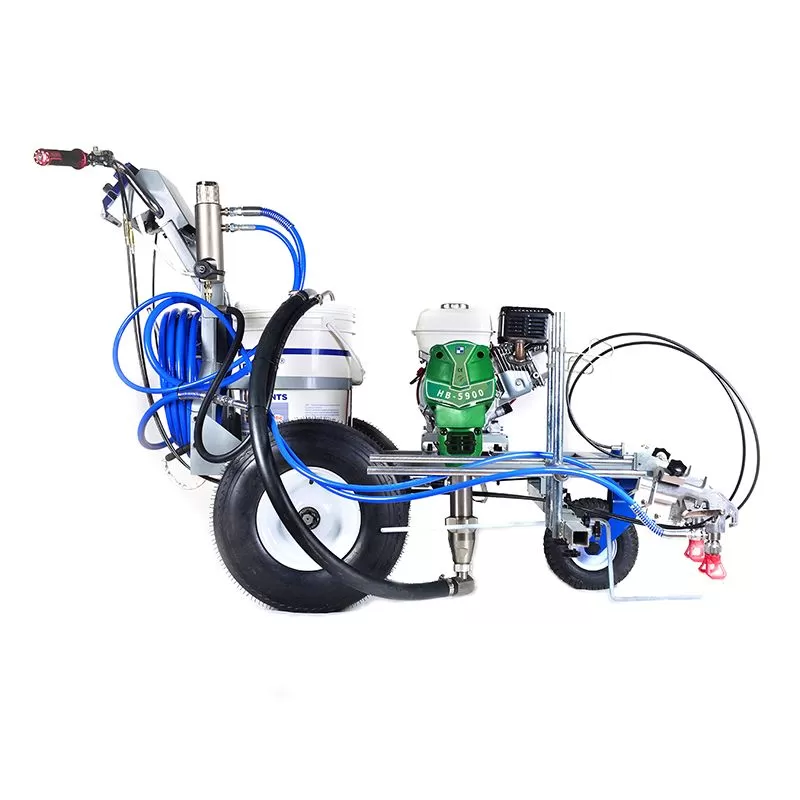
Application Demands Across Three Critical Environments
Line marking is never one-size-fits-all. A machine designed solely for striping parking stalls will struggle on a long-distance highway job, while an oversized airport striper lacks maneuverability in an urban garage. Understanding site conditions determines which machine architecture you need.
1. Commercial Parking Lots and Logistics Hubs
Parking facilities present distinct operational challenges:
- Tight turning radii between concrete pillars and curbs.
- Frequent stops and starts across short stalls and directional arrows.
- High pedestrian and vehicular traffic during business hours.
Contractors working on retail plazas and distribution centers need agile, walk-behind line stripers. These machines must cut clean lines with zero paint dripping at the start and cutoff points. Fast-drying acrylics and waterborne paints dominate these projects, requiring fluid systems that do not clog during brief operational pauses.
2. High-Speed Highways and Arterial Roads
Highway road marking demands production volume and extreme material durability. Long highway stretches require uninterrupted linear spraying, steady travel speed, and uniform paint application across thousands of meters. Pavement markings must meet strict retroreflectivity and durability metrics established by standard specifications such as ASTM D4061.
High-pressure delivery is essential here. The striper must push heavy-viscosity traffic paints onto porous asphalt and grooved concrete. Because highway lane closures are expensive and dangerous, contractors require high-capacity material tanks to eliminate continuous stops for paint refilling.
3. Airport Runways and Taxiway Aprons
Aviation facilities maintain the strictest pavement marking standards in the transportation sector. Airfield markings must adhere to rigorous civil aviation mandates, such as the surface marking guidelines documented in international runway marking standards.
Jet engine blast, aircraft tire friction, and harsh de-icing chemicals deteriorate substandard paint lines quickly. Runway applications require:
- Heavy-duty high-pressure atomization to bind high-solids, anti-skid coatings to grooved concrete.
- Wide-line capability to spray 12-inch to 36-inch marking patterns in uniform single passes.
- Precise glass bead distribution for nighttime pilot visibility.
2026 Flagship Industrial Road Striper: Engineering Specifications
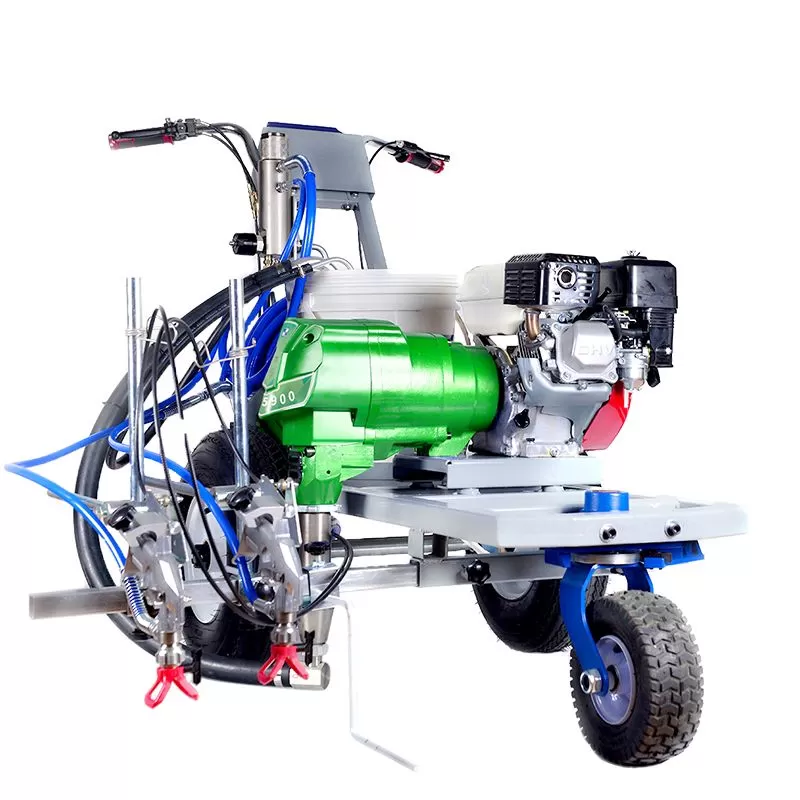
To meet the rigorous demands of both municipal infrastructure and heavy commercial layouts, modern paint line striping machines must combine industrial hydraulic output with operational balance. Below are the engineering specifications of the 2026 flagship line marking system manufactured by HVBAN:
- Overall Dimensions: 1450 mm × 900 mm × 1100 mm
- Equipment Weight: 400 kg (Provides grounded stability and dampens operational vibration)
- Power Output: 5.5 kW industrial-grade commercial engine
- Material Hopper Capacity: 100 Liters (Reduces refill intervals on large surface areas)
- Operating Pressure: 200 to 250 bar (High-pressure airless atomization)
- Primary Applications: Municipal highways, commercial logistics hubs, parking complexes, and airport runways
Core Mechanical Advantages on the Job Site
Consistent striping quality depends directly on hydraulic engineering, frame rigidity, and gun control mechanisms. Professional operators evaluate equipment based on uptime, line edge definition, and maintenance simplicity.
Sharp Edge Definition with High-Pressure Atomization
Mechanical paint rollers and low-pressure sprayers allow paint to bleed under wind guards, creating jagged, feathered edges. A specialized line striper operating at 200 to 250 bar forces high-viscosity coatings through precision spray tips. This mechanical force micro-atomizes the fluid, delivering crisp line borders and deep pore penetration on rough asphalt without overspray.
Heavy Chassis for True-Tracking Stability
A lightweight striping cart tends to drift off track when crossing pavement expansion joints, mill marks, and surface ruts. At 400 kg, the industrial-grade steel chassis anchors the machine to the pavement. The balanced center of gravity eliminates tip vibration, keeping the spray guns aligned with the mechanical pointer for laser-straight highway demarcation.
Ergonomic, Streamlined Control Console
Operator fatigue leads directly to wavy lines and contractor rework. Modern stripers position line-selection switches, pressure control dials, and gun engagement levers within immediate reach of the operator. Operators can adjust the spray pressure, disengage secondary guns, and manage directional tracking without halting work.
High-Capacity 100-Liter Reservoir
Refilling 20-liter pails every half hour slows production and increases the risk of spilled paint on fresh surfaces. An integrated 100-liter paint tank supports continuous spraying over long highway segments or massive logistics lots. Fewer stops mean higher daily square footage, lower labor costs, and reduced material contamination.
Operational Comparison: Standard Line Stripers vs. Heavy-Duty Hydraulic Stripers
Selecting the right equipment tier directly impacts project timelines, maintenance overhead, and total cost of ownership. The table below outlines how standard light-duty carts compare with heavy-duty hydraulic striping systems.
| Performance Factor | Light-Duty Commercial Striper | HVBAN Heavy-Duty Industrial Striper |
|---|---|---|
| Operating Pressure | 100 - 150 bar | 200 - 250 bar (High-Pressure Airless) |
| Paint Tank Volume | Direct from 20L Pail | 100L Heavy-Duty Hopper |
| Engine Output | 2.0 - 3.5 kW | 5.5 kW Industrial Engine |
| Pavement Tracking | Susceptible to ground bumps | High-stability 400 kg vibration-damping frame |
| Paint Compatibility | Thin traffic paints, light waterborne | High-solid waterborne, solvent-based, chlorinated rubber |
Why Road Marking Contractors Partner with HVBAN
Fluid handling machinery operates under abrasive conditions. Pumping thousands of gallons of silica-heavy traffic paint wears out internal valves, packings, and pressure seals quickly. Buying directly from an established manufacturer guarantees access to parts, consistent machining quality, and dedicated technical support.
HVBAN brings substantial manufacturing advantages to contractors and regional distributors worldwide:
- Two Decades of Fluid Dynamics Focus: Over 20 years of continuous research, product prototyping, and manufacturing precision in the airless spraying sector.
- Patented Innovations: Holding more than 40 national and international patents covering hydraulic pump drives, non-clogging fluid manifolds, and spray control valves.
- Certified Manufacturing Quality: Built in facilities adhering strictly to international standards, including certified ISO 9001 quality management systems and European CE machine safety directives.
- Proven Global Presence: Exported to more than 140 countries across Europe, North America, Southeast Asia, South America, and the Middle East.
- Full Lifecycle Support: Comprehensive parts supply chains,
rapid-dispatch wear kits, and professional engineering assistance for on-site
troubleshooting.
Global Distribution and OEM/ODM Manufacturing
Whether you need a dedicated paint line striping machine for specialized airfield maintenance or an entire fleet of industrial stripers for nationwide road contracts, HVBAN delivers customized equipment packages. Our manufacturing lines offer custom paint colors, engine brand options, specialized spray gun configurations, and bead dispenser integrations.
We are actively expanding our global distribution network. We invite equipment leasing companies, regional safety equipment distributors, and pavement maintenance dealers to join our partner program.
Direct OEM and Purchasing Inquiries:
Official Export
Department Email: mkt@fzhbgs.com
Contact
our technical sales team today to discuss regional distribution rights, request
equipment catalogs, or receive a fast quote for your upcoming paving
projects.
Frequently Asked Questions (FAQ)
Q1: What operating pressure is ideal for applying heavy-viscosity
highway traffic paint?
A1: Heavy-viscosity traffic coatings require
an operating pressure between 200 and 250 bar (approximately 2900 to 3600 psi).
This high pressure mechanically atomizes high-solid coatings without requiring
excessive chemical thinners. It forces the paint into the rough pores of aged
asphalt and concrete, ensuring long-lasting line adhesion and clear edge
definition.
Q2: Can HVBAN paint line striping machines handle both waterborne and
solvent-based paints?
A2: Yes. The fluid sections of HVBAN stripers
are machined from corrosion-resistant stainless steel and high-grade alloys,
paired with solvent-resistant fluid packings. This allows operators to spray
standard waterborne acrylics, solvent-based alkyds, and chlorinated rubber road
paints. Always flush the system thoroughly with the correct solvent when
switching between different paint chemistries.
Q3: How does a 100-liter paint hopper improve daily site
productivity?
A3: Standard stripers draw paint directly from
20-liter buckets, forcing operators to stop every 300 to 500 meters to switch
pails. An integrated 100-liter hopper reduces refilling stops by up to 75%. This
preserves your application rhythm, keeps the paint temperature uniform, and
increases daily marking output by hundreds of linear meters.
Q4: How do I prevent paint tip clogging during high-temperature
outdoor striping?
A4: Tip clogging usually occurs when paint dries
quickly inside the spray nozzle during brief stops. Use reversible airless spray
tips to clear minor blockages in seconds by rotating the tip 180 degrees.
Additionally, ensure paint passes through both a suction intake strainer and a
primary manifold filter before reaching the spray gun.
Q5: Does HVBAN offer OEM customization for regional
requirements?
A5: Yes. HVBAN provides complete OEM and ODM
customization for qualified regional dealers and fleet accounts. We configure
machines with specific engine brands, integrate single or dual automatic bead
dispensers, alter chassis setups for walk-behind or ride-on operation, and apply
custom corporate powder-coat branding directly at the factory.
Equip your contracting business with field-proven pavement marking technology. Email HVBAN today at mkt@fzhbgs.com to discuss machine configurations, request comprehensive spec sheets, and place your factory order.