
Every facility manager knows the headache. You order an entry-level line striper from a generic catalog to save a few dollars. Within three months, the plastic brackets crack, the pump clogs on high-viscosity epoxy, and the lines look like wobbly snakes across your staging bays.
Industrial concrete floors punish light-duty equipment. Between floor expansion joints, abrasive dust, and aggressive cleaning chemicals, cheap gear degrades fast. Keeping your warehouse floor safety lines sharp demands machinery built with genuine industrial-grade engineering.
At HVBAN, we engineer high-performance fluid application machinery built to endure relentless daily use in punishing industrial environments. If your operation is tired of throwing away flimsy sprayers and enduring costly rework, it is time to upgrade.
Planning to replace your aging striping equipment or upgrade your facility safety program? Contact our technical sales team today for an industrial line marking consultation and direct factory quotation.
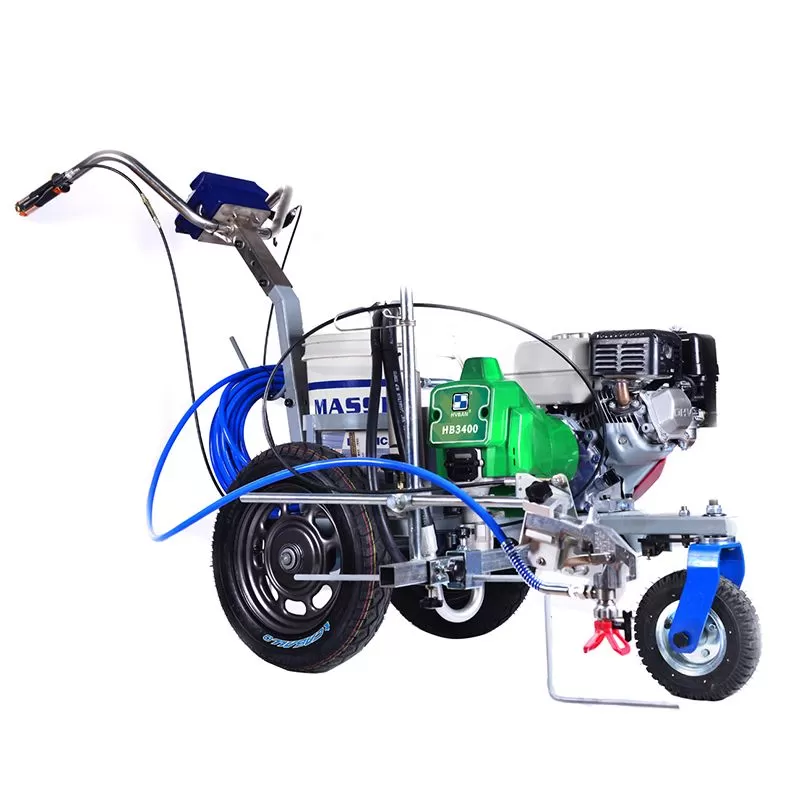
Why Industrial Warehouses Destroy Cheap Stripers
Warehouses are tough operating environments. Smooth polished concrete might look forgiving, but it hides severe structural challenges for marking machines. Every transition across an expansion joint sends shockwaves directly into the chassis and spray gun assembly.
Standard retail line stripers rely on stamped sheet metal, plastic fittings, and light aerosol cans or weak diaphragm pumps. These components flex under vibration. That flex distorts your spray angle, causing uneven line widths and blurry edges that violate internal safety standards.
Furthermore, standard consumer paints do not survive forklift traffic. Industrial facilities demand heavy-duty coatings like two-component epoxies, polyurethanes, and high-solids traffic paints. Pushing these thick, viscous materials requires immense hydraulic or mechanical pressure. Cheap machines either choke instantly or burn their packings within days.
If you want clear, straight, and compliant warehouse floor safety lines, you need a dedicated heavy-duty floor striper designed from the ground up to absorb physical shock and push thick industrial coatings.
The Top 5 Features of a Heavy-Duty Striper
When selecting a warehouse line marking machine, do not get distracted by cosmetic add-ons. Look beneath the surface at the structural engineering, fluid dynamics, and wear components. Here are the five mandatory features that separate throwaway tools from true 10-year assets.
Feature 1: Welded Heavy-Gauge Steel Chassis — No Cheap Plastics
The backbone of any durable paint applicator is its frame. If the frame flexes, your lines will drift. Entry-level units use bolted, thin-gauge tubing or plastic sub-assemblies that loosen over time, introducing mechanical play into the steering assembly.
A true commercial-grade warehouse line marking machine uses a solid, fully welded steel chassis built from tubular or boxed heavy-gauge steel. This unyielding rigidity delivers two non-negotiable benefits:
- Vibration Dampening: Heavy structural steel absorbs the motor and pump vibrations, ensuring the spray tip stays at a dead-steady distance from the concrete floor.
- Mechanical Alignment: Even if an operator accidentally bumps a structural rack or staging column, a solid steel frame will not bend out of true. Your front-to-back tracking remains laser-straight.
Look closely at the coating on the frame itself. Raw steel or cheap spray enamel will corrode quickly when exposed to floor cleaning detergents, battery acids, and paint thinners. Insist on a heavy-duty, baked-on industrial powder coating that resists chemical corrosion and physical abrasion.
Feature 2: Industrial-Grade Airless Pumping System
Gravity-fed rollers and aerosol sprayers have no business in an active distribution center. They sit on top of the concrete surface, leaving thin paint films that forklifts scrape away in weeks. Industrial aisle marking equipment must apply coatings under genuine high pressure.
A heavy-duty airless warehouse line marking machine relies on a hardened piston pump capable of producing 2,000 to 3,300 PSI. This hydraulic force atomizes thick traffic coatings without thinning them down with excess solvents, yielding three critical advantages:
- Deep Substrate Penetration: High-pressure spray forces paint down into the microscopic pores of concrete, creating an aggressive mechanical bond that stands up to heavy pallet jack traffic.
- Razor-Sharp Edges: Airless atomization produces defined, sharp edges without the cloudy overspray haze typical of pneumatic air-spray systems.
- Single-Pass Coverage: You lay down the correct dry film thickness (DFT) in a single pass, cutting labor hours in half and minimizing lane shutdown times.
Manufacturers like HVBAN focus heavily on hardened fluid sections. Look for pumps built with chrome-plated stainless steel piston rods and tungsten carbide valve seats. These materials resist the aggressive scouring action of silica and heavy pigments found in long-wearing safety coatings.
Feature 3: Heavy-Duty Wheel Assembly & True-Tracking System
Even the finest spray pump will produce messy lines if the wheels chatter or drift. Cheap stripers use small, rigid plastic wheels that catch in expansion joints, throwing the machine off course and creating unsightly jagged markings on your pristine floor.
Professional line marking machines utilize large-diameter, shock-absorbing wheels fitted with sealed industrial ball bearings. These bearings keep concrete dust, moisture, and paint debris away from the axle, ensuring smooth movement over years of operation.
Equally critical is a dedicated tracking lock mechanism. A solid tracking system allows the operator to lock the front wheel dead straight for long runs down rack aisles, or unlock it with a simple handlebar lever when executing tight radius turns around bollards and staging corners.
When the machine rolls straight by design, the operator does not have to fight the handlebars to maintain a straight line. This stability reduces physical fatigue and ensures parallel aisle marking from one end of the facility to the other.
Feature 4: Anti-Clogging Fluid Circuit & Tool-Less Maintenance
Downtime is the hidden killer of facility maintenance budgets. When a pump clogs with semi-cured paint, every minute spent searching for wrenches and soaking parts burns expensive labor. A durable paint applicator must be easy to clean and service.
Premium striping units feature specialized, high-pressure fluid manifolds and tool-free filter assemblies. These allow operators to pull and rinse internal filters in seconds without opening the primary fluid housing. Reversible spray tips are another operational necessity: when a tip picks up a clump of pigment, the operator simply turns the tip 180 degrees, blows the blockage out into a waste container, and resumes spraying immediately.
Pay special attention to the internal pump seals. Low-cost machines use synthetic rubber packings that swell and dissolve when exposed to xylene, acetone, or heavy mineral spirits. Heavy-duty units utilize self-adjusting PTFE (Teflon) and ultra-high-molecular-weight polyethylene (UHMWPE) packings that survive aggressive solvents without drying out or tearing.
Feature 5: Precision Edge-Banding Shields & Multi-Width Adjustability
A warehouse line marking machine must handle multiple line dimensions. OSHA and international workplace safety guidelines mandate distinct widths for distinct applications: pedestrian walkways often require 2-inch or 4-inch lines, while main transport thoroughfares and hazardous staging zones demand 6-inch bands.
A high-quality striper allows rapid, mechanical line-width adjustment by moving the spray gun arm vertically and horizontally without requiring specialized tools. Sturdy positioning bars keep the gun rigid at your desired height, ensuring the spray fan width never fluctuates mid-run.
To deliver crisp safety borders, top-tier machinery integrates floating mechanical shields or disk guards. These shields glide over concrete surfaces, containing paint droplets and blocking ambient wind drafts caused by open loading bay doors. The result is a clean, sharp line boundary with zero feathering.
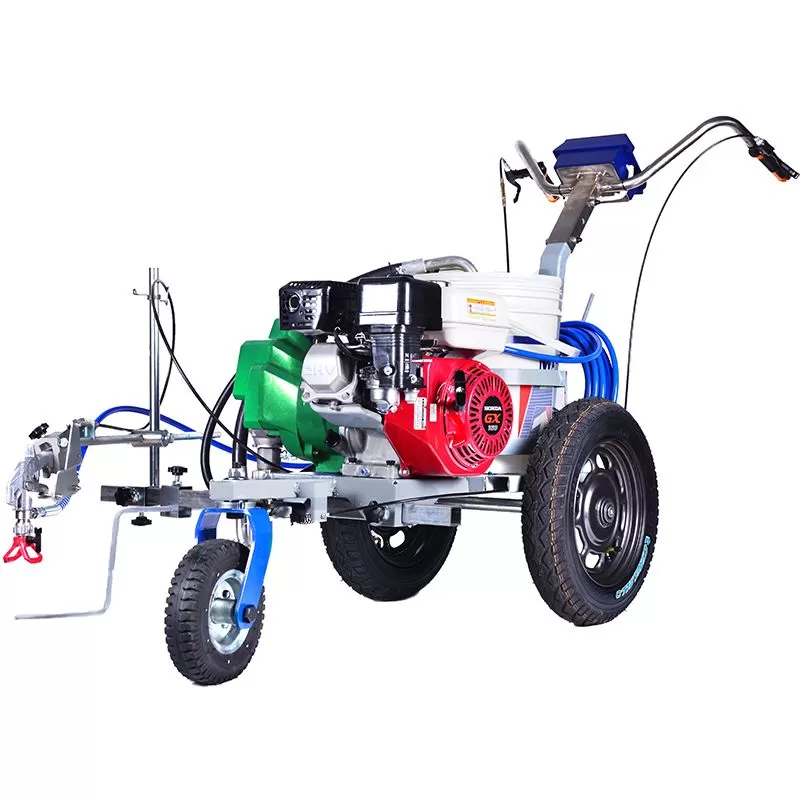
The ROI: Cheap Stripers vs. Industrial Heavy-Duty Machines
Purchasing managers are often tempted by lower upfront price tags. However, comparing an economy striper against an industrial-grade warehouse line marking machine through a total-cost-of-ownership lens reveals an obvious commercial reality.
- Labor Expenses: Cheap machines require multiple passes to apply thin paint, track poorly, and demand constant manual touch-ups with tape and rollers. Professional gear lays thick, uniform lines on the first pass at up to 100 feet per minute.
- Operational Downtime: Repainting faded lines every three months interrupts order picking and forklift traffic. Applying industrial-grade two-part coatings with a high-pressure striper yields lines that last two to three years under heavy forklift traffic.
- Paint Waste: Poor fluid control causes uneven application, overspray fog, and spilled material. High-efficiency airless equipment delivers up to 90% transfer efficiency directly to the floor surface.
- Equipment Replacement: Buying a $600 retail striper every year costs far more over five years than investing once in an industrial unit that retains its resale value and functions reliably for a decade.
An industrial warehouse line marking machine pays for itself after marking just two or three large facilities or completing a single comprehensive aisle re-striping project.
Frequently Asked Questions
Q1: Can I spray 2-part epoxy floor paint through a standard warehouse line marking machine?
A1: You can only spray two-component epoxy or polyurethane coatings if the machine is a high-pressure airless unit with solvent-resistant packings (such as PTFE) and a hardened fluid section. Gravity-fed or low-pressure aerosol machines cannot atomize high-viscosity epoxy, which will plug their internal passages permanently. Always flush two-part coatings immediately before the paint's pot life expires.
Q2: Why should I paint warehouse safety lines instead of using heavy-duty floor tape?
A2: While floor tape works well in low-traffic foot zones, forklift tires quickly twist, peel, and tear taped edges during pivot turns. Torn tape leaves sticky adhesive residues that trap dirt and look unsightly. High-pressure paint penetrates concrete pores directly, resisting tire scrubbing, pallet dragging, and moisture much longer than adhesive tape.
Q3: What routine maintenance keeps an industrial floor striper running for years?
A3: Flush the fluid section thoroughly with a compatible solvent (water for latex, mineral spirits or xylene for oil/epoxy) immediately after each use. Store the pump with pump conditioner or mineral spirits inside the manifold to prevent corrosion and keep packings lubricated. Clean the manifold filters, lubricate the front wheel caster bearing, and inspect the spray tip for wear regularly.
Q4: How do I get clean line starts and stops without paint pooling?
A4: Never pull the spray trigger while the machine is standing still. Start pushing the striper forward at a steady walking pace, pull the trigger when crossing your start mark, and release the trigger just before you stop rolling. Industrial stripers with mechanical cable-operated triggers provide immediate shutoff at the gun tip, preventing paint drips.
Q5: What nozzle or tip size is best for marking concrete warehouse floors?
A5: The right tip depends on your paint's viscosity and your target line width. For standard waterborne and solvent-based traffic paints, line-striping tips with a .017-inch to .021-inch orifice and a 2-inch to 4-inch fan pattern (such as 219 or 321 tips) are common industry standards. Thick epoxy floor coatings may require larger .023-inch to .027-inch tips driven by a powerful pump.
Invest in Equipment That Withstands the Floor
A warehouse floor safety program is only as good as the lines you mark. Blurred, crooked, or quickly peeling paint reflects poorly on plant operations and introduces serious safety hazards around transport corridors and pedestrian pathways.
Rather than burning maintenance hours on tools that break under standard use, equip your facility crew with a true heavy-duty warehouse line marking machine. By prioritizing a welded steel chassis, an industrial airless pump, high-performance tracking wheels, solvent-resistant seals, and precise line shields, you secure an asset that delivers straight, vibrant lines for years to come.
HVBAN manufactures a full line of heavy-duty pavement and floor striping machinery engineered to handle abrasive concrete surfaces and the toughest industrial coatings. Our machines provide the rugged reliability, ease of maintenance, and fluid control required by modern logistics and manufacturing facilities worldwide.
Ready to elevate your facility markings and streamline maintenance costs? Send an inquiry to HVBAN today to request technical specifications, view our complete machine catalog, or receive an immediate commercial quote.