
Short answer: a wandering line usually comes from the machine, not the painter. Check the front wheel tracking, tire pressure, gun offset, paint pressure, and guide line before you blame the operator.
A parking line striper works at low speed, in tight turns, and in short runs. That is a different job from long highway marking. The machine has to steer precisely, start and stop cleanly, and hold a constant line width while the operator walks a curve.
HVBAN builds airless line stripers for road and parking lot work, including the HS27-II, HS50, HS50-II, and H58. The models differ in power, flow, and pressure, but the line quality still depends on the same four things: chassis, guide, gun, and paint.
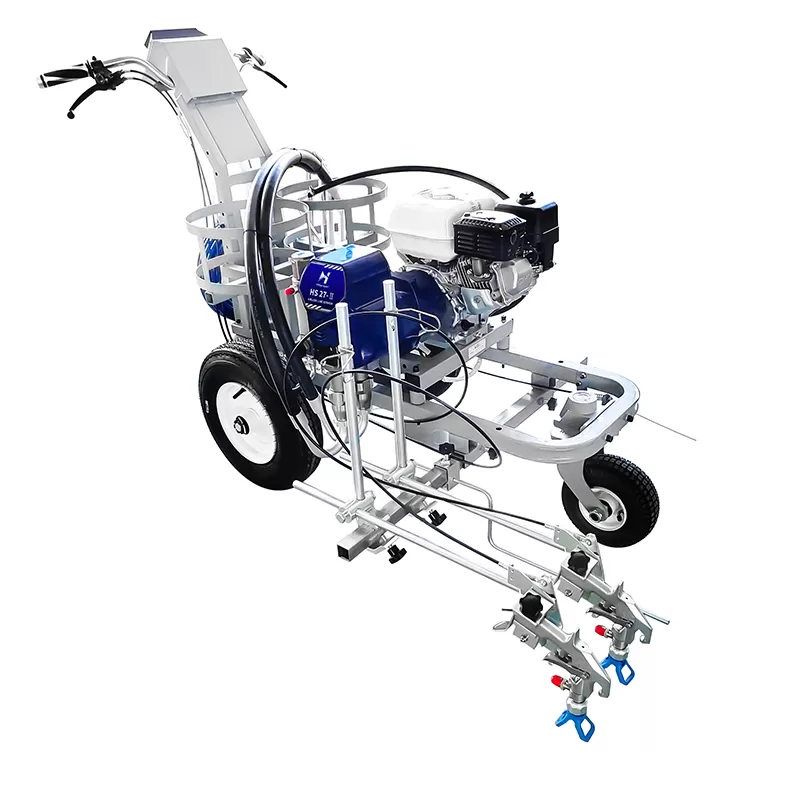
Parking Lot Striping Is Not Road Marking
A road marker runs long, straight passes at higher speed. A parking lot marker runs short passes, tight turns, and repeated layouts. The operator changes direction often and may switch between stall lines, arrows, and stencils.
That difference changes the machine priorities. Maneuverability matters more than top speed. A clean start and stop matters more than maximum flow. A stable gun height matters more than a long frame.
A large road striper can be awkward in a crowded lot. A compact machine with a tracking front wheel and a clear sight line to the gun is often faster on a 100-stall layout.
Why Parking Lines Wander
A parking line striper can pull to one side for mechanical reasons. The front wheel may not track, the tire pressure may be uneven, or the gun may be offset from the guide. The operator corrects the steering, and the line develops a wave.
| Symptom | Likely cause | Check |
|---|---|---|
| Line waves left and right | Front wheel not tracking or tire pressure uneven | Caster play, tire pressure, axle alignment |
| Line width changes | Gun height or nozzle worn | Gun height, nozzle size, tip condition |
| Line starts heavy, ends thin | Pressure drop or trigger timing | Pump pressure, hose length, gun trigger |
| Edge is fuzzy | Over-spray or wrong tip angle | Tip angle, gun distance, wind |
| Line drifts at a curve | Operator cannot see the guide | Gun offset, guide line, line driver |
The first check is the front wheel. A caster that is loose or bent will follow the ground instead of the guide. The second is the tire pressure; a low tire on one side pulls the chassis.
The third is the gun. If the nozzle is offset from the guide, the operator has to steer the machine to put the line in the right place. That correction is what makes the line wave.
The fourth is paint pressure. A drop at the gun changes the line width and the edge quality. Check the pump, the hose, and the filter before you adjust the nozzle.
HVBAN’s HS27-II and HS50-II Line Stripers
The range lists four airless line stripers for road and parking work. The HS27-II and HS50-II are the two models with the most published detail, and both use a two-component pump assembly.
| Model | Published power | Max flow | Max pressure | Notable feature |
|---|---|---|---|---|
| HS27-II | 4.1 HP | 5 L/min | 21 MPa | Honda GX, 360° front wheel |
| HS50-II | 3700 W / 3600 rpm | 8.8 L/min | 23 MPa | Two-component pump, line driver interface |
| H58 | 3700 W / 3600 rpm | 5.8 L/min | 23 MPa | Compact high-pressure unit |
The HS27-II is the smaller unit. It lists 4.1 HP, 5 L/min, and 21 MPa, with a Honda GX engine, a digital pressure panel, and a 360° self-adjusting front wheel. It is aimed at smaller lots and mixed work.
The HS50-II lists 3700 W / 3600 rpm, 8.8 L/min, and 23 MPa. It uses the same two-component pump assembly and adds a reserved interface for a line driver. That makes it the higher-output choice for larger layouts.
The H58 lists 3700 W / 3600 rpm, 5.8 L/min, and 23 MPa. It sits between the two on flow but uses the higher pressure class. Confirm the paint, the tip, and the line width with the factory before you choose.
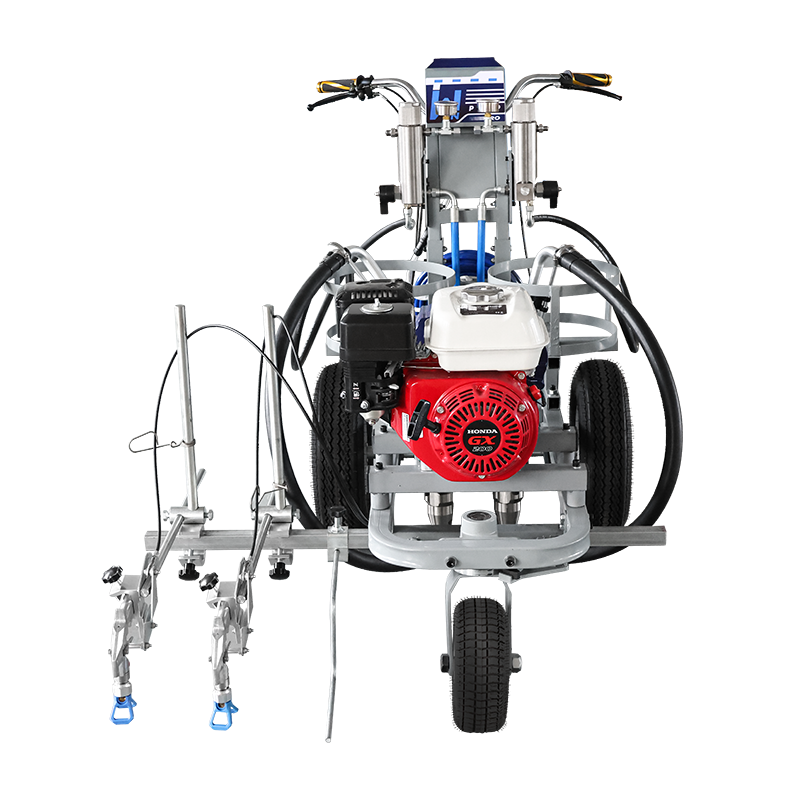
Six Specs That Decide Line Quality
| Spec | Why it matters | What to verify |
|---|---|---|
| Pump flow | Supports line width and walking speed | L/min at the gun, not only at the pump |
| Pressure | Atomization and paint flow | MPa at the tip, with the production hose |
| Gun and nozzle | Line width and edge quality | Tip size, angle, height, and spare parts |
| Two-component compatibility | Epoxy and MMA paints need ratio control | Dual pump, ratio, flush procedure |
| Chassis and front wheel | Tracking through turns | Caster play, tire pressure, axle alignment |
| Guide and line driver | Operator fatigue and straightness | Gun offset, line-driver interface, sight line |
Flow and pressure are a pair. A high-pressure pump with a small tip can starve a wide line at walking speed. A high-flow pump with a worn tip can flood the line. Match the tip to the line width and the paint.
Two-component paint adds a third variable: the mix ratio. The machine needs a dual pump or a ratio-controlled system, and the operator needs a flush procedure. A standard single-component pump will not meter the two parts correctly.
Paint, Surface, and Stencil
Parking lot paint may be waterborne, solvent-based, or two-component. Each has a different cure time, viscosity, and tip requirement. Follow the paint supplier’s data sheet; do not tune the machine by guesswork.
The surface has to be clean and dry. Oil, dust, and loose aggregate cause the paint to lift at the edge. A blower or a broom before the striper is part of the line quality, not an extra step.
Layout comes before paint. Set a string line or a chalk line, mark the first stall, and check the gun offset against the guide. A test line on a scrap area shows whether the machine tracks before you commit the layout.
For stencils, check the gun height and the overspray. A stencil that is not held flat will produce a soft edge. Glass beads, if used, need a separate dispenser and a consistent drop rate.
The Test Line Audit
- Surface: clean a 10 m strip and let it dry.
- Guide: set a straight string line and mark the gun offset.
- Pressure: set the production pressure and check it at the gun.
- Pass: spray a steady walking pass at the normal speed.
- Measure: check width at the start, middle, and end; check the edge with the string.
- Beads: if used, check coverage and drop rate before the paint cures.
If the line wanders, stop and check the wheel, tire, gun, and guide in that order. Do not correct a mechanical drift with steering; the next pass will wander again.
Send the team the lot size, stall count, paint type, line width, surface, and daily output. The team can recommend a model and a tip/nozzle set for the layout.
When you choose a parking line striper, compare the tracking, the gun offset, the pump flow, and the paint compatibility, not only the engine size. Use the HVBAN contact page or email mkt@fzhbgs.com. For the models, see the HS27-II page and the HS50-II page.
Frequently Asked Questions
Q1: What does a parking lot striper do?
A1: It is an airless paint sprayer on a wheeled chassis, with a gun that sprays parking stall lines, arrows, and stencils. It may use waterborne, solvent, or two-component paint.
Q2: Why do my parking lines wander?
A2: The common causes are a loose front caster, uneven tire pressure, a gun offset from the guide, or a pressure drop at the gun. Check the machine before you correct the operator.
Q3: Can one striper spray two-component paint?
A3: Only if it has a dual pump or a ratio-controlled two-component system. The range lists a two-component pump assembly on the HS27-II and HS50-II. Confirm the ratio and flush procedure for the paint.
Q4: Can the striper apply glass beads?
A4: The range lists an optional glass bead dispenser on the line striper frame. The bead drop rate has to be set for the paint and the line width.
Q5: How do I test a new line striper?
A5: Spray a 10 m test line on a clean, dry surface. Check the width at three points, the edge against a string, the pressure at the gun, and the bead coverage if used.
Sources
- ISO 9001, quality management systems.
- ISO 12100:2010, safety of machinery — general principles for design, risk assessment, and risk reduction.