
Applying high-solids protective barriers across extensive commercial roof profiles represents one of the most demanding fluid application disciplines. Commercial roofing substrates—spanning corrugated metal, standing seam, modified bitumen, and single-ply membranes—demand uniform membrane build without structural overloading. Deploying an airless spray gun for roof painting requires balancing hydraulic pressure generation, laminar flow stability, tip shearing capabilities, and physical mechanical fatigue on industrial crews. Understanding the mechanical intersection between fluid viscosities, delivery line friction, atomization geometries, and substrate adhesion dynamics allows operations managers and specifying engineers to achieve targeted dry film thicknesses (DFT) while minimizing overspray losses and operational down-time.
Fluid Rheology and Mechanical Demands in Commercial Roof Coatings
Roofing formulations differ radically from standard architectural emulsions. Protective coatings engineered for rooftop exposure frequently utilize high-build elastomeric acrylics, high-solids silicones, solvent-borne polyurethanes, and asphaltic emulsions. These materials exhibit distinct rheological profiles, predominantly thixotropic or pseudoplastic behavior, characterized by apparent viscosities ranging from 5,000 to over 30,000 centipoise (cPs) at resting states.
Atomizing non-Newtonian fluids without adding excessive thinners—which compromise protective elastomeric integrity and breach environmental VOC compliance—necessitates exceptional kinetic energy transfer at the spray orifice. An airless system relies entirely on fluid compression rather than pneumatic atomization. The fluid is propelled through a precisely dimensioned tungsten carbide orifice under hydrostatic pressures reaching 2,500 to 4,000 pounds per square inch (PSI). As the coating exits the micro-orifice into atmospheric pressure, rapid depressurization disrupts cohesive surface tension forces, shearing the liquid stream into a fine, directed fan pattern.
Thermal variations across roof elevations complicate application. Surface temperatures on dark bitumen or metal decks frequently exceed 60 degrees Celsius, accelerating flash-off times and skin-over rates. Conversely, early morning ambient temperatures increase base viscosity, presenting greater hydraulic resistance across the supply system. The spray applicator hardware must manage these viscosity shifts without clogging, fluid cavitation, or irregular fan tailing.
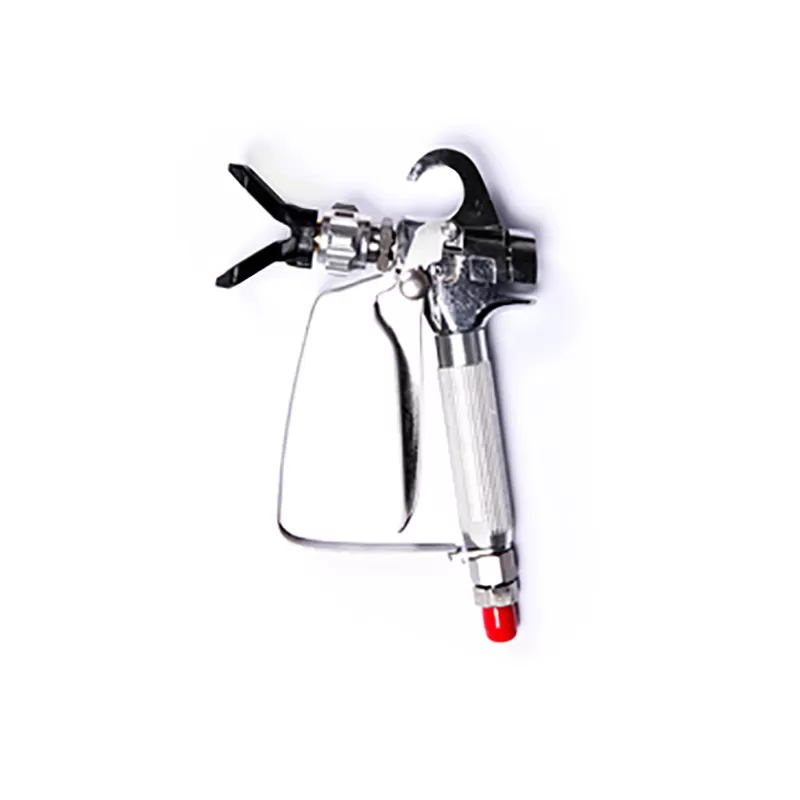
Mechanical Design Requirements of an Airless Spray Gun for Roof Painting
Commercial roof painting environments expose fluid equipment to continuous pressure cycling, abrasive solids (such as titanium dioxide and calcium carbonate pigment extenders), and physical impacts. A field-grade spray applicator must incorporate robust metallurgical assemblies to preserve performance margins.
Wetted Fluid Passages: High-solids roof coatings can react aggressively with standard zinc or low-grade aluminum alloys. High-performance units utilize micro-honed, passivated stainless steel or proprietary hardened alloys throughout the core fluid conduit to eliminate internal flaking, pitting, and material buildup.
Needle Assembly and Shut-Off Geometry: The needle and seat bear the brunt of mechanical wear under intense hydrostatic loads. Premium systems incorporate matched tungsten carbide needle tips paired with resilient ceramic or carbide ball seats. The needle design must isolate mechanical springs from the wet fluid cavity to prevent particulate packing around moving linkages, which can trigger intermittent shut-off lag, spitting, and pressure drops.
Internal Sealing Arrays: Standard PTFE (Teflon) packings often degrade rapidly when exposed to abrasive elastomeric slurries or aggressive aromatic solvents found in moisture-cured polyurethanes. UHMWPE (Ultra-High-Molecular-Weight Polyethylene) and fluoroelastomer hybrid packings offer superior abrasion resistance and dynamic memory, reducing premature throat packing leakage during continuous cycling.
Integrated Swivel Mechanics: Maneuvering rigid 3/8-inch or 1/2-inch fluid lines along steep-pitch roofs or around parapet walls generates immense wrist and forearm torque. Heavy-duty live swivels with low-friction internal bearings allow uninterrupted rotation under maximum operational pressure, improving operator control while preserving hose longevity.
Equipment manufacturers such as HVBAN design balanced trigger linkages and contoured handle profiles directly around these mechanical stressors, lowering the mechanical force required to break hydraulic seat resistance and minimizing repetitive strain injuries across multi-hour production windows.
Pressure Dynamics, Delivery Hose Runs, and System Sizing
Roofing projects frequently present unique geographic routing constraints: high-displacement pumps typically remain stationary at ground level, requiring fluid transport through vertical risers and horizontal runs spanning 50 to 120 meters. Hydraulic head loss and internal frictional resistance drop the dynamic pressure delivered to the applicator tip.
Selecting the right airless spray gun for roof painting hinges on understanding fluid shear rates and volumetric throughput. Operating high-solids elastomeric coatings through a typical 100-meter line requires calculating pressure loss through Darcy-Weisbach friction equations. For instance, pumping a 15,000 cPs elastomeric compound through a continuous 3/8-inch inner diameter hose line over a 20-meter vertical rise can cause a continuous line-loss drop of 60 to 100 bar (870 to 1,450 PSI). If the applicator hardware restricts flow through narrow internal geometries or unoptimized 90-degree internal fluid elbows, net atomization pressure falls below the threshold required to fracture the fluid ligament, leading to heavy edge banding (tailing) and uneven coating deposition.
To offset these operational variables, contractors size their fluid distribution with stepped-down inner diameter hoses, transitioning from a 1/2-inch primary line to a 3/8-inch supply line, and finishing with a 1.5-meter to 3-meter 1/4-inch whip hose connecting to the applicator. The gun itself must support an internal orifice dimension capable of passing up to 4 to 8 liters per minute without imposing turbulent backpressure on the pump’s lower displacement cylinder.
Tungsten Carbide Tip Selection and Orifice Engineering
The spray tip is the primary governing component for atomization quality, fan width geometry, and liquid volume control. Spray tips carry a standard numeric designation that indicates spray pattern width and orifice size. For instance, a 521 tip produces a 10-inch (approx. 250 mm) fan when held 300 mm from the substrate, with an orifice diameter of 0.021 inches.
Selecting the optimal tip profile for roofing requires matching coating solid percentages to orifice diameters:
Bituminous Primers and Low-Viscosity Sealers (25% to 45% solids): Orifice sizes between 0.015 and 0.019 inches provide sufficient shearing while maintaining flow velocity to prevent surface saturation or runs on sloped metal surfaces.
High-Build Acrylic Elastomerics (55% to 70% solids): Require tip apertures ranging from 0.021 to 0.027 inches to prevent mechanical cavitation and needle clogging while maintaining adequate wet film thickness in fewer passes.
100% Solids Silicones and Solventless Polyurethanes: Heavily thixotropic formulations often demand orifice sizes from 0.027 to 0.035 inches, paired with high-ratio hydraulic or gas-mechanical displacement pumps running minimum pressure ratios of 45:1 to 65:1.
Reversible spray tips, commonly referred to as RAC (Reverse-A-Clean) configurations, are an operational requirement. When spraying elastomeric mastics, particulate agglomeration or unmixed pigment flakes will periodically choke the micro-orifice. A reversible housing allows operators to rotate the carbide core 180 degrees, fire the trigger momentarily into a waste vessel to clear the obstruction, and return to application mode within seconds, eliminating manual disassembly at elevated heights.
Industrial procurement teams collaborating with HVBAN benefit from customized fluid passages and optimized tip housing alignments that preserve tip seat tolerances, ensuring uniform spray patterns and reducing wear across extensive shifts.
Mitigating Elevated Wind Loss, Drift, and Transfer Efficiency
Rooftop environments present persistent cross-wind challenges. Wind currents across an open industrial roof deck quickly carry off micron-scale paint droplets. Overspray drift creates severe liability risks regarding adjacent vehicles, HVAC air intakes, and surrounding structures, while diminishing material transfer efficiency down to 50% or less.
Transfer efficiency is maintained through precise pressure modulation and tip technology rather than simply increasing pump force. Over-pressurizing the coating increases fluid velocity beyond what is necessary to shear the stream, atomizing a high percentage of particles into sub-50-micron satellite droplets. These micro-droplets possess insufficient kinetic mass to pierce air turbulence and instead drift as airborne mist.
Modern low-pressure reversible tip geometries alter the internal pre-orifice channel, allowing full, tail-free atomization at 30% to 50% lower hydrostatic pressures compared to traditional carbide tips. Droplet size distribution shifts away from fine mists toward larger, uniform droplets that resist aerodynamic displacement. Applying an elastomeric coating at 1,800 PSI with an optimized low-pressure tip instead of 3,200 PSI with a worn tip significantly lowers overspray risks, improves transfer efficiency toward 80%, and cuts mechanical component fatigue on the fluid pump packings and gun seats.
Field mechanics also deploy spray shields, windbreak enclosures, or specialized extended spray pole configurations. Poles ranging from 1 to 2 meters allow the operator to keep the spray tip strictly perpendicular to low-slope decks at an exact distance of 30 to 40 cm without requiring the worker to stoop, directly addressing physical fatigue and preserving spray geometry.
Preventive Maintenance, Wear Cycles, and Teardown Protocols
Abrasive roofing compounds aggressively erode fluid handling pathways. Titanium dioxide, quartz aggregate, and ceramic micro-spheres act as liquid sandpaper when moving at sonic velocities through the tip throat. As the carbide orifice wears, it does not simply enlarge; it erodes into an irregular oblong shape, resulting in a narrower fan width and heavier center volume (tailing). A worn tip can waste up to 25% more coating material via excessive localized mil-build before the operator notices visible defects.
Maintaining high production standards requires strict daily operational disciplines:
In-Line Filtration Inspection: The handle filter inside the gun acts as the final defense against tip blockage. When running heavily filled roofing elastomers, mesh sizes must be selected correctly. Using a 100-mesh filter on thick silicone leads to rapid clogging and internal pressure drops; operators must down-gauge to a 30-mesh or 60-mesh stainless steel core filter, or remove the handle filter entirely if running materials with structural fibers, relying instead on primary manifold filters at the pump.
Chemical Flushing Protocols: Waterborne acrylics demand thorough flushing with warm, clean water mixed with non-foaming detergent, followed by a storage flush using pump-conditioning fluids or mineral spirits to prevent flash-rusting of internal components. Moisture-cured silicones and polyurethanes react with atmospheric moisture; systems running these coatings must be completely flushed using aromatic solvents (such as xylene or toluene) and stored under solvent to avoid catastrophic internal polymer curing.
Dynamic Packing Adjustments: Periodic inspection of the packing adjustment nut behind the trigger prevents coating migration into the needle spring pocket. If coating residue appears on the trigger release shaft, the packing nut must be tensioned to spec, or the seals must be rebuilt with an appropriate repair kit.
Mechanical Rebuild Procedures: Standard high-volume cycles require rebuilding the needle-and-seat package roughly every 5,000 to 10,000 liters of high-solids fluid moved. The teardown requires unscrewing the front fluid housing, extracting the worn carbide seat and needle assembly using brass drift tools, and applying low-friction anti-seize lubricants to thread interfaces upon reassembly.
Structural Setup and Operational Safety on Pitched Substrates
Deploying an airless spray gun for roof painting on multi-story metal or membrane roofs demands strict operational and pressure management protocols to protect equipment life and worker safety.
Pumps must be grounded via dedicated copper earth stakes to mitigate static electricity hazards. High-velocity fluid movement through non-grounded hoses creates significant electrostatic charges. If a static discharge occurs near solvent-based volatile primers or open venting flashings, combustion hazards escalate rapidly. Grounding continuity between the pump chassis, fluid hose wire braiding, the spray gun body, and the metal substrate must be verified with an ohmmeter prior to pressurization.
High-pressure fluid injection injuries represent a severe industrial hazard. With system pressures exceeding 200 bar, a minute stream escaping from a loose coupling or pinhole puncture easily breaches skin barriers. Industrial applicators must never be operated without functional trigger safety latches and secure tip guards. The tip guard does not shape the fan pattern; it serves as a mechanical standoff barrier to prevent human contact with the high-velocity hydraulic stream at the orifice face.
Field Inspection Protocols and Quality Assurance for Applied Membranes
Contractual guarantees on commercial roofs rely on strict mil-thickness adherence. Undersaturated coatings crack prematurely under thermal contraction cycles, whereas excessive local thickness leads to solvent or water entrapment, blistering, mud-cracking, and compromised adhesion.
Systematic inspection requires crews to measure Wet Film Thickness (WFT) continuously using stainless steel notched gauges directly following each spray stroke. Calculating desired WFT from dry film target specifications requires factoring the volume of solids:
Required WFT = Desired DFT / Volume Solids percentage
For an acrylic elastomer containing 60% solids by volume aimed at a finished DFT of 500 microns (approx. 20 mils), the applicator must maintain a constant WFT of 833 microns (approx. 33 mils). Establishing a cross-hatch, 50% overlap pattern with an airless spray gun for roof painting balances out edge variations inherent to fluid fan profiles. Maintaining steady gun translation speed (roughly 0.5 to 1 meter per second) and strict perpendicular orientation to the profile corrugations guarantees that the coating bonds evenly to both vertical steps and flat deck channels.
Component Longevity and Total Cost of Ownership
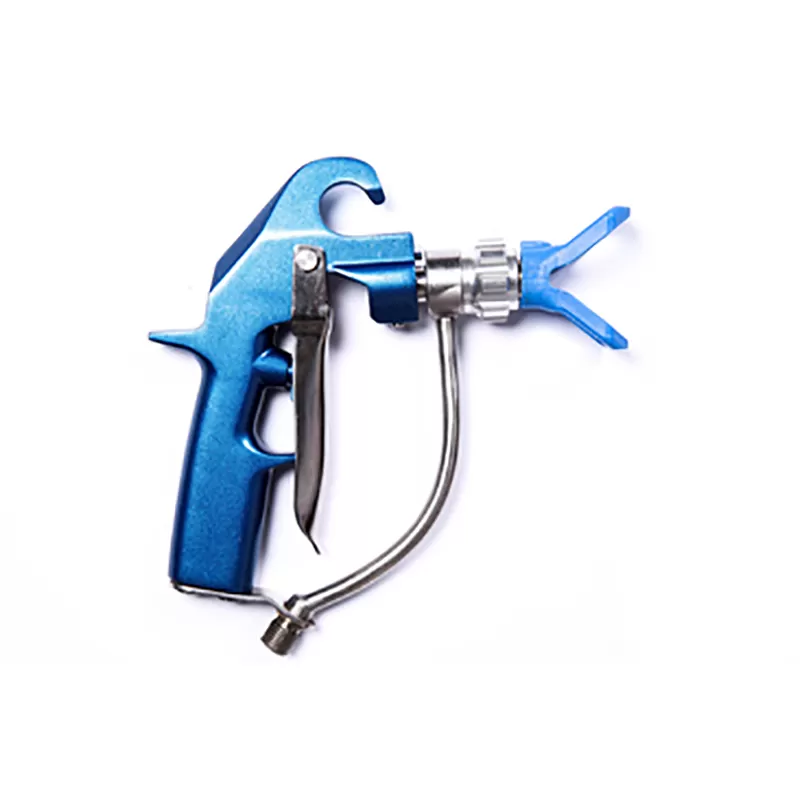
Equipment buyers must look beyond initial acquisition costs to assess long-term operational impact. Standard, light-duty sprayers fail rapidly when subjected to the abrasive solids, dynamic pressures, and harsh rooftop environments common in this sector. Evaluating total cost of ownership for an airless spray gun for roof painting involves measuring wear intervals across needles, seats, tip geometries, and fluid swivels.
Applicators designed for rapid field rebuilding minimize costly job-site downtime. A crew forced to stop production on an industrial roof can incur hundreds of dollars per hour in idle labor costs while dealing with potential coating set-up risks within static supply lines. High-grade industrial guns mitigate this by offering single-cartridge modular valve replacements, allowing the needle and packing assembly to be swapped in minutes without complex workshop tools.
Frequently Asked Questions
Q1: What is the primary cause of fluid tailing or fingering when
spraying elastomeric roof coatings?
A1: Tailing—characterized by
heavy bands along the outer edges of the fan with insufficient center
atomization—results from insufficient atomization energy. This occurs when pump
operating pressure is too low, the fluid delivery hose inner diameter is
undersized for the run distance, or the selected tip orifice is too large for
the fluid viscosity. It can also stem from an oversized tip that exceeds the
displacement volume output of the pump motor.
Q2: Why should handle mesh filters sometimes be eliminated when
applying high-solids roof coatings?
A2: Highly viscous elastomeric
paints, silicones, and fiber-reinforced coatings contain thick binder chains and
coarse mineral pigment fractions that struggle to cross fine filtration screens.
Operating with standard 60 or 100-mesh handle filters can cause a major pressure
drop across the grip, trigger premature drying within the handle channel, and
cause rapid filter blinding. Applicators often remove handle filters entirely
for materials with over 65% solids, relying instead on high-capacity primary
pump rock-catchers and manifold-mounted wire mesh screens.
Q3: How do standard RAC tips compare to fine-finish or low-pressure
tips in commercial roof work?
A3: Standard RAC tips require high
operational line pressures (often 3,000+ PSI) to atomize high-viscosity
coatings, which generates considerable overspray drift in breezy roof
conditions. Low-pressure reversible tips utilize stepped internal pre-orifice
chambers that disrupt fluid cohesive forces earlier, achieving uniform
atomization at lower operating pressures. This reduces wind drift, lowers
material loss, and slows the wear rate of the carbide orifice.
Q4: How frequently should tungsten carbide tips be decommissioned and
replaced during commercial roof projects?
A4: Service life depends
entirely on the abrasive properties of the specific coating formulation. When
moving high-aggregate, heavily filled acrylic primers, a standard carbide tip
may begin losing its dimensional accuracy after 2,000 to 4,000 liters. Silicones
without abrasive pigments allow longer duty intervals. A tip should be
decommissioned when the fan width narrows by 25% or when applied wet film
thicknesses begin climbing unexpectedly in the center of the spray profile.
Q5: Can an industrial airless gun handle both solvent-based asphaltic
coatings and waterborne acrylics interchangeably?
A5: Yes, provided
the internal packing materials are compatible with both formulations. Modern
sprayers utilizing virgin PTFE or UHMWPE dynamic packings are impervious to
hydrocarbon solvents, aromatics, and water. However, the cleaning and flush
protocol between material changes must be strictly managed: flushing directly
from waterborne acrylic to a solvent-borne bituminous coating will cause
chemical shock, coagulating the paint instantly within the supply line and gun
body. A neutral intermediate solvent or alcohol stage must be integrated to
purge the system fully during transitions.
Engineering Collaboration and Industrial Equipment Sourcing
Reliable high-viscosity coating application requires a cohesive system setup, balancing pump output, hose engineering, tip geometry, and applicator design. Co-engineering efforts between coating formulators and HVBAN fluid handling specialists demonstrate how purpose-built fluid delivery systems consistently meet DFT performance targets while withstanding abrasive wear in demanding environments. For technical specifications, custom OEM parts, and high-pressure fluid engineering guidance, contact our team below to connect with an equipment specialist.
Request Engineering Specs and Technical Quotations