
High-volume architectural coatings demand rigorous fluid handling equipment capable of continuous operation under extreme hydraulic pressures. Within commercial and large-scale residential construction, the mechanical application of paints, primers, and high-build block fillers relies predominantly on hydraulic atomization rather than compressed air assistance. Selecting the appropriate airless house paint sprayer involves understanding fluid dynamics, mechanical drive assemblies, structural metallurgy, and lifecycle wear patterns. Procurement teams, fleet managers, and engineering directors must evaluate equipment through a lens of total cost of ownership, duty cycle reliability, and operational output parameters rather than superficial metric comparisons.
Pneumatic spray setups rely on compressed air breaking the fluid stream at the air cap, which introduces significant overspray, air turbulence, and transfer inefficiencies. Hydraulic atomization forces unthinned, high-viscosity coatings through a precisely machined tungsten carbide orifice at pressures ranging between 1,500 and 3,300 pounds per square inch. Upon discharge into atmospheric pressure, the sudden change in kinetic energy causes the liquid stream to fracture into a finely distributed fan of droplets. This mechanical transformation ensures transfer efficiencies that frequently exceed 70 percent, reducing wasted coating volume while maintaining the film build necessary to meet commercial architectural specifications.
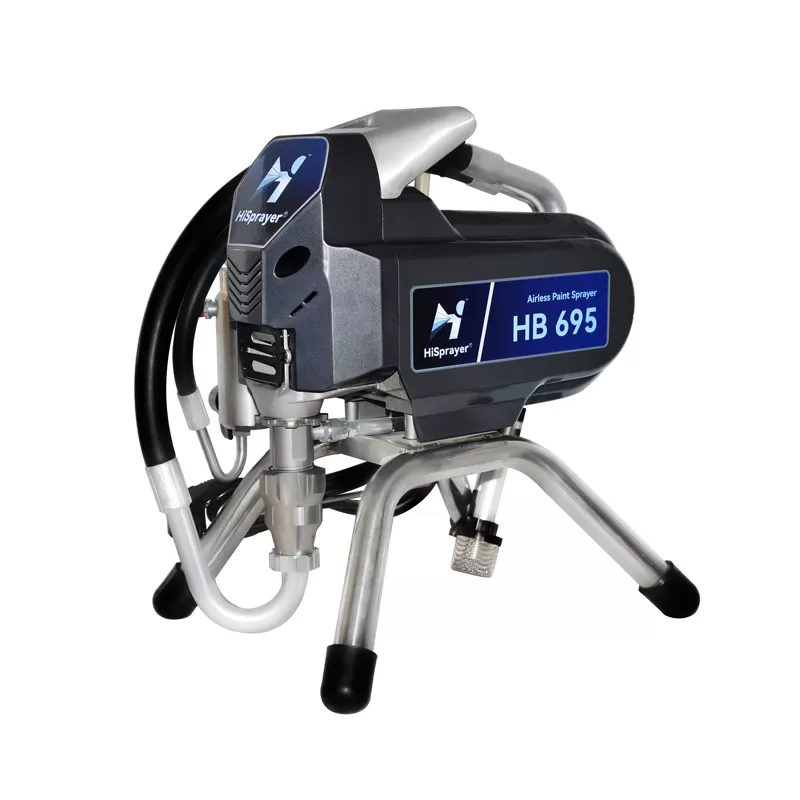
Fluid Mechanics and Hydraulic Atomization Principles
Understanding the mechanical operation of high-pressure fluid displacement begins at the fluid manifold and the pumping chamber. Architectural coatings—specifically 100% acrylic emulsions, elastomeric barriers, and heavy latex formulations—exhibit non-Newtonian, shear-thinning (thixotropic) rheological behavior. Under static storage conditions, these materials exhibit high dynamic viscosity. As the pump forces the fluid through the intake valve, the cylinder, and the narrow passages of the fluid lines, high mechanical shear rates reduce the apparent viscosity, allowing fluid flow without requiring solvent addition or water thinning.
The core mechanism that dictates spray pattern integrity is fluid velocity coupled with tip geometry. As pressurized fluid exits the fluid section, it encounters a restriction calibrated down to fractions of an inch. Commercial spray tips feature internal contours designed to prevent vortex creation, ensuring that fluid velocity remains laminar until the precise instant of atmospheric release. When evaluating an airless house paint sprayer, the hydraulic stability of the fluid section directly affects the atomization threshold. If the pump cannot maintain sustained dynamic pressure during trigger actuation, the fluid velocity drops below the critical atomization threshold, resulting in irregular spray edges commonly known as "tails" or "banding."
Hydrodynamic Shearing: Forces molecular alignment in polymer chains, temporarily lowering viscosity without altering film-forming attributes.
Kinetic Atomization: Converts fluid pressure directly into surface area expansion, forming uniform micron-sized droplets without introducing external air.
Transfer Efficiency: Maximizes coating solids deposition directly onto the substrate, mitigating airborne particulate migration and reducing substrate preparation labor.
Structural Topologies: Piston Pump versus Diaphragm Configurations
Industrial spray equipment relies fundamentally on two fluid displacement topologies: reciprocating piston pumps and hydraulic diaphragm systems. Each architecture serves specific operational parameters across modern contracting environments.
Reciprocating positive displacement piston pumps represent the prevailing choice for architectural coatings. These systems operate through a double-acting displacement cycle, displacing fluid on both the upstroke and downstroke to provide consistent system pressure. The piston rod passes through an arrangement of stationary and dynamic packings. Top-tier machinery utilizes a combination of Ultra-High Molecular Weight Polyethylene (UHMWPE) and premium leather packings. UHMWPE provides superior abrasion resistance against abrasive filler pigments such as titanium dioxide and calcium carbonate, while leather packings absorb lubricating oils and seat tightly against micro-imperfections on the pump cylinder wall. Leading equipment programs, including those engineered by HVBAN, integrate micro-honed fluid sections with heavy chrome or ceramic coatings on the piston rod to resist premature scoring from abrasive architectural particulates.
Diaphragm pumps utilize a hydraulically driven flexible membrane to displace fluid. Because there are no dynamic packings rubbing against a moving piston rod, diaphragm units experience minimal mechanical friction wear within the fluid chamber. These designs perform exceptionally well with lower-to-medium viscosity fluids, stains, and clear finishes, offering high reliability in sustained lower-pressure environments. Their primary limitation arises when cycling extremely high-viscosity materials or high-build primers, where the mechanical suction stroke of a diaphragm cannot match the positive intake velocity generated by a submerged foot valve on a long-stroke piston pump.
Pressure Management, Motor Topologies, and Fluid Controls
Operational stability depends on the engineering synergy between the motor, mechanical drivetrain, and pressure control interface. Continuous production duty cycles generate substantial thermal loads across the drive assembly, requiring robust electrical architectures and gearing profiles.
Modern commercial fluid sprayers increasingly incorporate brushless DC (BLDC) motors. Unlike traditional brush motors, BLDC architectures eliminate mechanical commutators, thereby mitigating internal sparking risks, lowering electromagnetic interference, and providing continuous torque throughout the entire rotational speed spectrum. This capability allows the system to cycle slowly during low-output applications without overheating, while immediately responding with high rotational torque when large-orifice spray tips demand immediate fluid displacement.
Pressure regulation mechanisms dictate the functional deadband—the pressure delta between when the spray gun trigger is opened and when the motor compensates to replenish fluid volume. Mechanical pressure switches exhibit wider deadbands, which can translate to inconsistent dry film thickness across continuous production passes. Microprocessor-driven electronic pressure control systems continuously sample fluid pressure via solid-state transducer sensors. These electronic systems modulate motor RPM dynamically, flattening the pressure curve down to minimal deadband tolerances and delivering a uniform spray profile from the beginning of the stroke to the end.
Procurement Criteria: Selecting the Right Airless House Paint Sprayer for High-Volume Application
Corporate procurement teams and equipment rental fleet managers must evaluate spray machines using verified engineering metrics rather than generalized output claims. The compatibility of an airless house paint sprayer with modern architectural formulations hinges upon matching operational duty requirements to component capabilities.
Maximum Tip Orifice Rating: The fluid output volume of a pump must comfortably exceed the volumetric flow demand of the maximum specified tip size. For light residential varnishes and lacquers, a pump supporting a 0.015-inch tip suffices. High-volume commercial elastomeric, block fillers, and intumescent passive fire protection coatings require configurations supporting tips ranging from 0.027 inches to 0.035 inches or larger.
Continuous Flow Delivery (GPM/LPM): Rather than relying strictly on free-flow pump capacity, examine flow delivery under sustained operational pressure (e.g., 2.0 to 4.0 liters per minute at 2,000 PSI). Pumps operating near their mechanical limit experience accelerated thermal decay and premature valve wear. Specifying an operational overhead factor of 25% extends continuous equipment service life.
Substrate Reach and Fluid Hose Geometry: Long vertical rises on commercial building facades induce substantial hydrostatic head loss and frictional fluid resistance. Heavy-gauge industrial pumps must generate sufficient dynamic pressure to overcome line losses across 150 to 300 feet of high-pressure fluid hose without degrading the tip atomization profile.
Internal Filtration Architecture: Reliable systems utilize multi-stage filtration grids to prevent particulate matter from reaching the fluid orifice. A standard configuration involves a coarse inlet rock catcher, a primary manifold core filter, and a secondary micro-mesh filter located directly inside the spray gun handle.
Field Failures, Fluid Contamination, and Tribological Wear
Operational downtime in commercial painting applications is almost universally tied to fluid section degradation, particulate abrasion, or improper maintenance hygiene rather than electrical motor failure. Understanding wear dynamics allows maintenance technicians to intervene before cataclysmic pump seizure occurs.
Piston rod scoring represents the most pervasive mechanical failure mode. Architectural paints contain solid suspension particles that possess high Mohs hardness values. When coating material dries on the upper packing gland due to a lack of throat seal lubrication, dried paint flakes transform into dynamic abrasives. Every stroke of the piston forces these hard crystals against the packing rings and the hard-chrome surface of the rod, cutting microscopic channels along the displacement path. Once micro-channeling occurs, high-pressure fluid bypasses the upper packing seals, venting pressurized paint into the drive housing and rapidly eroding internal mechanical clearances.
Cavitation presents another severe maintenance vulnerability. If an operator utilizes a suction hose that is undersized, kinked, or clogged with dried paint residue, the negative pressure on the inlet cycle drops below the vapor pressure of the coating solvent or water carrier. Vapor bubbles form instantly within the fluid path. As the displacement stroke begins, the sudden pressure transition collapses these microscopic cavitation bubbles with intense localized hydraulic shockwaves. This phenomenon erodes metal surfaces, pitting stainless steel intake seats, chipping tungsten carbide ball valves, and inducing irregular pressure waves across the delivery line.
Preventive maintenance regimens must dictate strict flushing protocols tailored to dynamic coating chemistry. Running water-reducible vinyl-acrylic paints requires thorough flushing with warm, clean water followed immediately by an anti-corrosive, non-freezing storage fluid. Solvent-borne epoxies and polyurethanes require precise multi-stage solvent transitions to avoid precipitating resins out of solution inside the manifold channels. Equipment fleets supported by HVBAN benefit from standardized component access, enabling field mechanics to service dynamic packings and exchange valve seats using standard hand tools without disassembling the primary drivetrain.
Site Deployment, Safety Dynamics, and Fluid Line Engineering
Safe operation of high-pressure spraying hardware necessitates rigorous protocols centered around fluid injection hazard mitigation, electrical grounding, and high-pressure hose management.
High-pressure fluid streams present an extreme skin penetration hazard. Fluid escaping an orifice at pressures exceeding 1,000 PSI effortlessly pierces dermal layers, injecting toxic chemicals deep into underlying tissue. This type of trauma requires immediate emergency surgical intervention to alleviate compartment pressure and excise foreign chemical material. Every deployed industrial airless house paint sprayer must be paired with operational safety components, including functional gun trigger locks, structural tip guards, and pressure release valves engineered to vent fluid manifold pressure back to a waste reservoir safely.
Static electricity generation represents another distinct hazard during continuous paint delivery. As non-conductive, solvent-rich coatings flow at high velocity through synthetic fluid lines, friction causes electrostatic charges to accumulate along the hose walls. If a conductive metal path to earth ground is broken, an electrostatic spark can jump to nearby grounded metallic surfaces, igniting ambient volatile organic compound (VOC) vapors. High-pressure hoses designated for commercial applications must incorporate continuous internal grounding wires or conductive synthetic braids, paired with grounded equipment chassis and power supplies verified by standard electrical continuity tests.
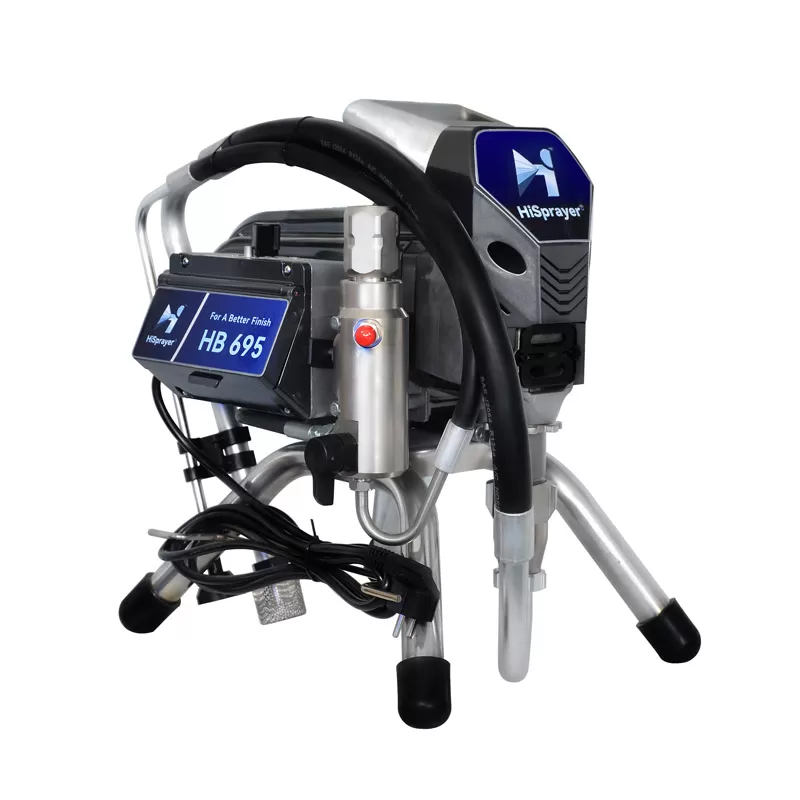
Lifecycle Management, Customization, and Fleet Integration
From an enterprise asset allocation standpoint, fluid machinery must demonstrate predictable performance across multi-year amortization schedules. Achieving this requires moving past standard off-the-shelf procurement and developing programmatic relationships with manufacturers capable of delivering specialized adaptations. OEMs and large industrial outfits frequently demand modular fluid ends, custom gear ratios for unique coating formulations, and ruggedized cart assemblies that withstand transport across uneven jobsite terrain.
Manufacturing platforms engineered by HVBAN offer procurement teams scalable integration pathways, from localized component assembly down to complete OEM and ODM fluid equipment configurations. By prioritizing tight dimensional tolerances during the machining of pump manifolds, eccentric gear sets, and valve cages, equipment life cycles are naturally extended. Standardized component architectures across fleet assets streamline spare parts inventory requirements. Field technicians can maintain fewer SKUs for packing kits, ball valves, and pressure transducers, driving down overall operating costs while maximizing equipment uptime across demanding construction schedules.
Frequently Asked Questions
Q1: How do fluid packings wear out, and what are the indicators of impending failure?
Packings wear down due to constant mechanical friction against the moving piston rod, compounded by abrasive pigment fillers in paint formulations like titanium dioxide. The first indicator of failure is paint seeping upward into the throat seal wet cup or onto the upper pump housing. Further operational signs include the pump cycling continuously without the gun being triggered, or a pronounced loss of dynamic working pressure when operating under normal tip load.
Q2: What is the mechanical difference between maximum working pressure and dynamic working pressure?
Maximum working pressure (often rated at 3,000 or 3,300 PSI) is the peak static pressure the pump can generate when the fluid outlet is completely closed and no coating material is leaving the system. Dynamic working pressure is the real-time pressure the system can continuously sustain while the gun trigger is depressed and fluid is discharging through the spray tip. Procurement specifications should focus primarily on sustained dynamic flow rates under specific orifice sizes.
Q3: Why is fluid line diameter critical when operating an airless house paint sprayer over long distances?
Fluid viscosity generates internal drag against the inner walls of the hose, creating a pressure drop that increases with line length. Utilizing a 1/4-inch internal diameter hose over distances exceeding 100 feet leads to substantial pressure loss at the spray tip, resulting in poor atomization. Upgrading to a 3/8-inch internal diameter line reduces fluid velocity and wall friction, preserving system pressure over long runs before stepping down to a shorter, flexible 1/4-inch or 3/16-inch whip hose at the gun for operator ergonomics.
Q4: Can a single high-output pump operate multiple spray guns simultaneously?
Yes, provided the pump's continuous delivery rating (GPM or LPM) comfortably exceeds the combined flow requirements of the chosen tip sizes. For example, operating two guns simultaneously with 0.019-inch tips requires a pump with a minimum continuous flow rating of roughly 0.70 to 0.80 gallons per minute at dynamic operating pressure. Attempting this with an undersized machine causes instantaneous pressure collapse, starving both applicators and producing uneven atomization.
Q5: What causes pressure surges and "tailing" in the spray pattern during high-volume production?
Tailing—uneven distribution characterized by heavy bands at the outer edges of the spray fan—occurs when the dynamic fluid pressure falls below the threshold required to fully fracture the coating viscosity at the tip. This can result from choosing a tip orifice that exceeds the pump's delivery output, a clogged manifold filter, dynamic packing leakage, or an inadequate electrical supply causing voltage drop to the motor under heavy load.
Procurement and Engineering Inquiries
For industrial contractors, distributors, and fleet managers seeking specialized fluid management equipment, custom OEM configurations, or high-output pumping systems, HVBAN provides direct engineering and manufacturing support. Submit your fleet requirements, operational parameters, and fluid specification inquiries directly to our technical procurement group at mkt@fzhbgs.com to receive detailed equipment documentation and supply chain solutions.