
Common residential painting scenarios include interior walls in new homes, renovation of older homes, and exterior walls of villas. Each scenario requires the right spraying equipment, spray gun, tip, and accessories to balance efficiency and quality.
This article covers the key factors to consider when selecting equipment for residential painting and compares several HVBAN airless sprayers to help you choose the right model for your needs.
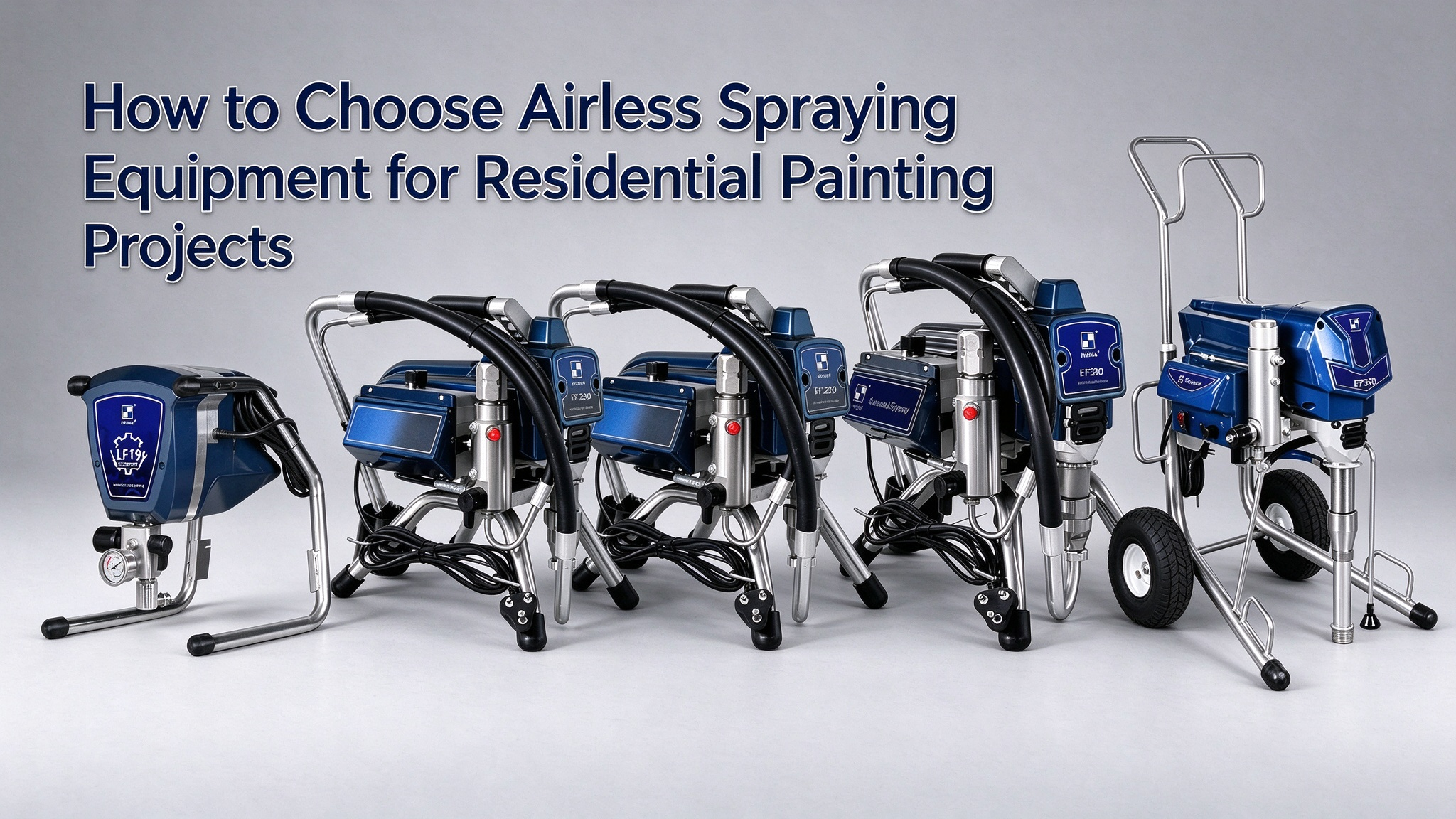
1. Key Factors in Choosing a Sprayer for Residential Painting
Residential projects differ from industrial coating work. Most take place in residential communities and are constrained by factors such as mains power availability, carrying equipment into the home, noise restrictions, and homeowner acceptance standards. For this reason, electric airless sprayers are generally the first choice for residential painting.
HVBAN's electric airless sprayer series features high-quality brushless DC motors that are stable, durable, and quiet. The product range is complete, covering small, medium, and large flow models to meet the needs of different job scenarios. When choosing a model for different scenarios, the following factors must be considered:
1.1Pump Flow Rate
Pump flow rate determines the maximum tip size you can run, how thick a coat you can apply in a single pass, and how stable the sprayer is during continuous operation. It is the first selection criterion for residential painting equipment.
Construction scenarios | Recommended model flow rate |
Small apartment/home renovation | 1.8~2.5Lpm |
Full exterior primer application for self-built homes and villas | 2.8~3.5Lpm |
Waterproofing, anti-corrosion, and elastomeric coatings for villas | ≥4Lpm |
1.2 Coating Type
Different coatings vary widely in viscosity, so different models are required. Use the table below as a guide for model range:
Coating Type | Coating Viscosity | Model Flow Rate Range |
Interior latex paint, wood topcoat, and varnish | low viscosity | Small to medium flow models |
Exterior latex paint, exterior primer | medium viscosity | Medium flow models |
Elastomeric coatings, JS waterproof coatings, epoxy primer | high viscosity | Medium to large flow models |
1.3 Weight, Portability, and Material Feed Method
For home painting, lightweight vertical models such as HVBAN's EP series electric sprayers are preferred.
The portable cart and handle design makes it easier to move the unit between rooms. All EP series electric sprayers can be upgraded to a folding portable cart version, which is especially practical for large apartment units and duplex or multi-level homes.
In addition, drawing material directly from a bucket via suction tube is efficient and commonly used in residential work. For small batches of tinted paint or small-area touch-ups and color changes, a small hopper model is more convenient. The HVBAN LF19 supports both suction tube and hopper operation—one machine, two uses.
2. Recommended HVBAN Models for Different Job Scenarios
Job scenario and target, project scale, and timeline are all factors that must be considered in a painting project. HVBAN offers the following reference solutions:
Construction scenarios | Recommended Model | Key Advantages |
DIY and home renovation | LF19 / EP230 | Lightweight, easy to clean, high interior spraying efficiency, and excellent finish quality |
Professional home painting and long-term residential renovation work | EP270 | Market-proven, stable and durable, suitable for both interior walls and standard exterior walls—a mainstream model in today's market |
Villa and self-built home exteriors, high-volume elastomeric coating work | EP310 / EP350 | Ample flow, some models support dual-gun simultaneous operation, and stable output with thick coatings |
The table below provides a quick comparison of key specifications across models:
Model | Max. Flow Rate | Rated Power | Max. Tip Size |
LF19 | 1.9Lpm | 800W | 0.021'' |
EP230 | 2.3Lpm | 1300W | 0.021‘’ |
EP270 | 2.7Lpm | 1500W | 0.025‘’ |
EP310 | 3.1Lpm | 2200W | 0.029‘’ |
EP350 | 4.0Lpm | 2500W | 0.033" single gun / 0.019" dual gun |
For more information, use the links below:
HVBAN LF19 Product Details
HVBAN EP230 Product Details
HVBAN EP270 Product Details
HVBAN EP310 Product Details
HVBAN EP350 Product Details
3.HVBAN EP270 Product Details
It must be emphasized that equipment and tip must be selected as a matched set. Different job scenarios, coating viscosities, and even project timelines all have their own suitable equipment and tip combinations.
If the tip is too large, each pass applies too thick a coat, which can easily cause sagging, peeling, uneven film thickness, unstable pressure, and overspray. An oversized tip not only wastes coating but also puts extra load on the equipment, increasing wear on the pump and seals.
Likewise, a tip that is too small—or prolonged use of an undersized tip—greatly reduces efficiency and spray quality. First, material output is slow, making large-area work inefficient. Second, thicker coatings or primers containing fillers can easily clog the tip. Third, an undersized tip accelerates wear on the pump, gun, and other seals.
HVBAN provides recommended tip sizes for each model. You can also learn more about tip selection in the article below: https://www.hvbansprayer.com/post/how-to-choose-the-right-airless-spray-tip-and-pressure-a-complete-selection-guide
Choosing equipment is only one part of a painting project. Product documentation, compatible accessories, and technical support are equally important. Through HVBAN, you can access:
l Product specifications: Quickly review the key parameters of different models.
l Operation manuals: Consult the relevant technical documents before operating or maintaining equipment.
l Spare parts support: Visit the HVBAN Spare Parts page for information on related accessories.
l Technical support: Contact HVBAN through the contact page for help with model selection and application requirements.
If you need to consult HVBAN, we recommend providing the coating type, estimated project area, required tip size, and frequency of use. This information helps narrow down the equipment selection.
FAQ
Q1: What is the most important parameter when choosing an airless sprayer for residential painting?
A: Pump flow rate (Lpm) is the first selection criterion. For small apartments, choose 1.8–2.5 Lpm; for exterior primer on self-built homes and villas, 2.8–3.5 Lpm; for waterproofing and elastomeric thick coatings, ≥4 Lpm is recommended. Flow rate determines the maximum tip size, spraying stability, and continuous operation capability.
Q2: How do I choose a model based on coating viscosity for residential painting?
A: For low-viscosity coatings such as interior latex and wood varnish, choose small to medium flow models. For medium-viscosity coatings such as exterior latex and primer, match with medium flow models. For high-viscosity thick coatings such as elastomeric coatings, JS waterproof coatings, and epoxy primer, choose medium to large flow models to ensure smooth output and prevent clogging.
Q3: What problems can an oversized or undersized tip cause?
A: Oversized tip: the coating can easily be too thick and sag, film thickness becomes uneven, pressure is unstable, overspray wastes coating, and wear on the pump and seals increases. Undersized tip: material output is slow, large-area work is inefficient, thick coatings with fillers clog easily, and seal wear accelerates. Equipment and tip must be selected as a matched set.
Q4: Which HVBAN models are recommended for DIY home renovation versus professional long-term residential work?
A: For DIY home renovation, LF19 and EP230 are recommended—lightweight, easy to clean, and suitable for interior wall spraying. For professional contractors doing long-term residential renovation, EP270 is the top choice—stable, durable, and suitable for both interior walls and standard exterior walls. For villa exteriors and high-volume elastomeric coating work, consider EP310 and EP350—ample flow, with some models supporting dual-gun operation.
Q5: What information should I prepare before consulting HVBAN for model selection advice?
A: We recommend preparing the coating type, project area, planned tip size, and equipment usage frequency so our team can quickly provide an accurate model recommendation.