
A contractor bought his first machine on price alone. On the first job, the 100 mm line sprayed thin at normal walking pace, and the rework cost him two days. A second buyer picked a unit so heavy that one person could not lift it onto a pickup, so every job started with a phone call to a friend.
Most bad purchases trace back to the same gap. The buyer compares prices instead of jobs. This guide sets out a six-step method for choosing a parking line striping machine: job size, power source, pressure and flow, gun setup, paint compatibility, and upkeep. HVBAN has built fluid spraying equipment for 20 years and ships to more than 140 countries, so every figure below comes from a machine in production.
If you already know your lot sizes and annual stall count, send them to HVBAN for a model recommendation before you shortlist anything.
Start With the Job, Not the Machine
Five questions settle more than any spec sheet. Answer them in writing before you open a catalogue.
- How many lots will you stripe in a year?
- How many stalls does a typical lot hold?
- Is the work indoors, outdoors, or both?
- Is the surface asphalt, concrete, or a mix?
- Are you billing labour only, or supplying the paint as well?
Now sort the answers into three bands. Under 500 stalls a year is small-volume work: a small lot, a few re-stripes, maybe one school or church contract. Between 500 and 3,000 stalls is the commercial core, where output per hour starts to matter. Above 3,000 stalls, downtime costs more than the machine, and dual guns and spare parts become the deciding factors.
A crew striping 300 stalls a year and a crew striping 6,000 should not buy the same unit, even if both call the work "parking lot striping". Writing the number down first is the cheapest decision you will make.
Why Airless Wins in Parking Lots
Airless and air-assisted machines both spray paint, but they work differently. Air-assisted systems use compressed air to shape the fan. Airless systems push the coating through a small tip at 20 MPa or more, and the pressure alone atomizes it.
That matters because parking lot coatings are thick. Water-based acrylic and high-solids paints need pressure to break up properly. Run them through a low-pressure system and you get a thin, gritty line that wears out in a season.
- One-pass film build. A heavy coat covers old markings without a second trip.
- Low overspray. Almost no mist drifts onto kerbs, cars, or nearby walls.
- Wind tolerance. Gusts do not blow the pattern apart the way they do with air spray.
- No compressor. Fewer parts to carry, fewer parts to fail.
That is why roughly nine in ten parking lot jobs run airless. The 21 to 23 MPa band, about 3,000 to 3,300 psi, covers the coatings most contractors meet in the field.
Gas, Electric or Battery
Power availability decides this, not personal preference. A gas unit with a Honda GX engine starts in cold weather, runs all day on a tank, and needs no outlet. That suits remote lots, airfields, and long continuous runs where the nearest socket is a hundred metres away.
Electric units suit indoor garages, warehouses, and noise-sensitive sites. A 3700 W motor holds pressure steadily, but it needs a circuit that can carry the load without tripping. Check the breaker, the cable length, and the voltage before the machine arrives.
Battery machines are growing in mid-size lots. They are quiet and easy to move, but range and battery replacement add cost. Do the arithmetic on a full season before you commit.
A quick decision order
- Is reliable power available on site? If not, choose gas.
- Is the work indoors or near homes? If yes, choose electric.
- Does a single job run longer than the battery? If yes, choose gas or electric.
- Is the lot small and the crew one person? Battery starts to make sense.
Pressure and Flow: The Two Numbers That Matter
Two numbers decide what a parking line striping machine can do on site, and most buyers read only one of them.
Pressure, in MPa or psi, sets how well the coating atomizes and how thick a paint it can handle. Flow, in litres or gallons per minute, sets how much material moves through the system. A machine with high pressure and low flow sprays a fine line slowly. A machine with high flow and low pressure sprays fast but leaves a coarse edge.
- 21 MPa and 5 L/min. Comfortable for one gun, mid-size lots, and standard acrylics.
- 23 MPa and 8.8 L/min. Holds pressure with two guns running, or one large tip at full rate.
- 23 MPa and 5.8 L/min. A middle setting for indoor garages and steady commercial work.
Ask for the flow at the pressure you will actually use. A peak figure printed on a badge tells you very little about a Tuesday morning on a 200-stall lot.
Line Width, Guns and Multi-Line Work
Line width is not a setting you dial in. It comes from the tip, the gun height, and how fast you walk.
A tip number such as 517 reads in two parts. The first digit gives the fan width in half inches, so 5 means a 10 inch fan. The last two give the orifice in thousandths of an inch, so 17 means 0.017 inch. Change the tip and the line width changes with it.
- 50 to 100 mm. Stall dividers and standard lot markings.
- 100 to 150 mm. Access aisles, fire lanes, and main traffic lanes.
- 200 to 300 mm. Road edges, crossings, and industrial yards.
One gun covers most parking work. A second gun doubles output on long runs but splits the flow, so the pump has to keep up. Arrows, letters, and accessible-bay symbols need a hand gun and a stencil, which is a separate skill from straight-line work.
Paint Compatibility
Three coating families cover most of the market, and each asks something different from the pump.
- Water-based acrylic. The default for lots. Easy to flush, low odour, fast dry.
- Solvent-borne. Tougher film, stronger smell. Check that seals and hose are rated for it.
- High-solids epoxy. Long life on concrete, but short pot life. Flush before it gels, or the pump is scrap.
Thermoplastic is a different machine class. It is applied hot, at 180 to 220 °C, with a screed box or a specialised spray unit, and no airless pump handles it. Be wary of any supplier who blurs the two categories.
Dilution and filtration are the quiet killers. Over-thin the paint and the line fades early. Use too fine a filter and the tip clogs mid-lot. Use too coarse a filter and grit scores the pump. Follow the coating maker's sheet, then write the settings on the machine so the next crew repeats them.
Chassis, Wheels and One-Person Handling
Walk-behind units cover the vast majority of parking work. Ride-on machines only earn their price on very large lots, airports, and long road runs.
The front wheel matters more than the brochure suggests. A 360-degree self-adjusting wheel tracks an edge without constant correction and turns inside a tight aisle. A fixed wheel is cheaper and harder on the operator's wrists by the end of a shift.
Weight is the other daily cost. Kerbs, pickup beds, and stairwells decide whether one person can work alone. Test it plainly: can one person lift the unit into a pickup bed without a ramp? If not, budget for a trailer or a second pair of hands on every job.
Daily Output Math
The output of a parking line striping machine is easy to estimate once you accept two numbers: metres per hour and a realistic efficiency factor.
A standard stall carries about 15 metres of line. At a theoretical 300 metres per hour, that is 20 stalls an hour. Nobody hits the theoretical figure, because layout, repositioning, and refilling all take time. Plan on 60 to 70 percent, which gives 12 to 14 stalls an hour.
Worked example: a 200-stall lot
Two hundred stalls means roughly 3,000 metres of line. At 13 stalls an hour, the job takes about 15 hours, or two working days for a two-person crew. Paint use lands near 100 to 120 litres for a 100 mm line at normal film thickness, including waste.
That number is useful in three ways. It sizes the machine, it prices the job, and it tells you whether a second gun would pay for itself. Run the same arithmetic on your own lots before you compare machines.
Compliance and Line Quality
Rules vary by country, so check the code that governs the site rather than the one you learned at home. In the United States, accessible parking commonly follows a 2.44 m stall with a 1.52 m access aisle, with local amendments on top. Many markets expect a 100 mm line width for stall dividers.
Inspect three things before you sign off a lot. Straightness along the full run. Edge definition on both sides of the line. Opacity over old markings. If a line needs two passes to cover, the machine is underpowered for that coating, not badly operated.
Export projects add a fourth check: the certificate and standard the buyer accepted at order stage. A CE-marked machine and a UL-listed one are not interchangeable, even when they look identical.
Maintenance, Spares and Uptime
Uptime is a purchasing decision, not a workshop habit. A machine that needs a week for a seal kit costs more than the one that costs 20 percent more up front.
- Daily flush. Five minutes at the end of the shift beats an hour of cleaning next week.
- Filters. Replace on schedule, not when the pressure drops.
- Tips. Swap when edges start to feather or the fan narrows.
- Seal kits. Keep one on the shelf for every pump on the truck.
Work out what an idle hour costs. Two people, a truck, and a closed lot add up fast. If a 40 dollar tip saves two hours, the tip is not an expense. That logic sets a sensible spare-parts budget for the season.
Overseas buyers should weigh the service side heavily. Ask for the parts list with part numbers, the maintenance manual, and video support in your language. HVBAN supplies a spare-parts kit with each export order for exactly this reason.
Total Cost and Payback
Five lines make up the real cost: machine price, paint, labour, maintenance, and depreciation. Most buyers only compare the first.
Paint and labour usually eat 40 to 60 percent of a re-stripe invoice. A cheaper machine that wastes paint or needs a second pass can cost more per job than an expensive one that lays a solid line at walking pace.
Payback in jobs, not months
Divide the machine price by the profit you keep from one average lot. A unit that costs 3,000 dollars and earns 500 dollars of margin per lot pays for itself in six lots. Two lots a month and the machine is clear inside a quarter.
Then compare that figure with a subcontractor quote for the same work. If the subcontractor charges 700 dollars and you keep 500, the machine only makes sense once you have the volume to fill the calendar.
Model Match: What Each Build Is For
No single parking line striping machine covers every lot, and HVBAN builds four that split the range by job type rather than by price.
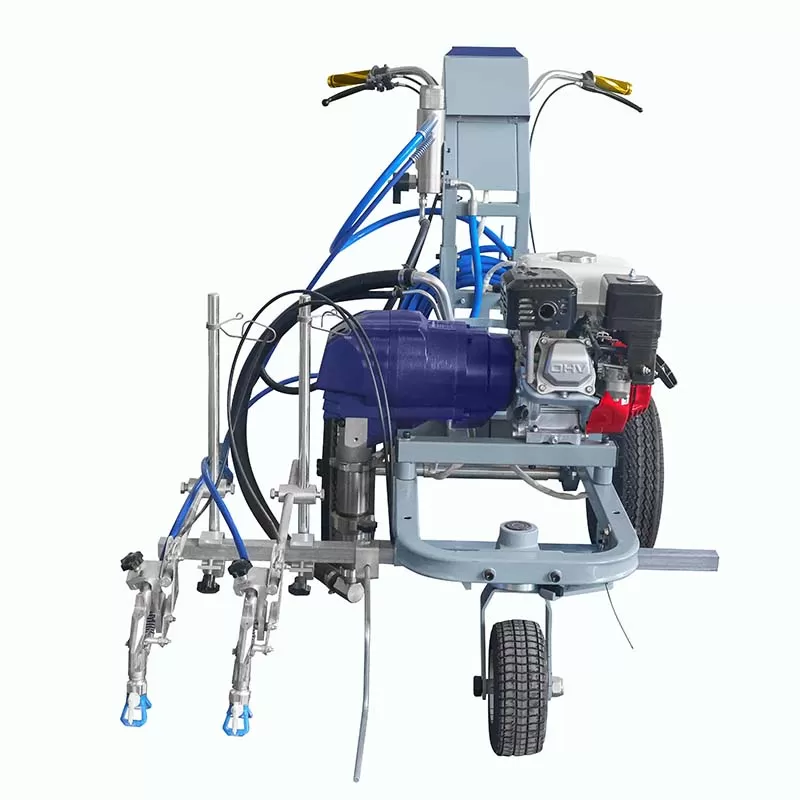
- HS27-II. Gas, 4.1 HP, 5 L/min, 21 MPa. Mid-size lots and sites with no power.
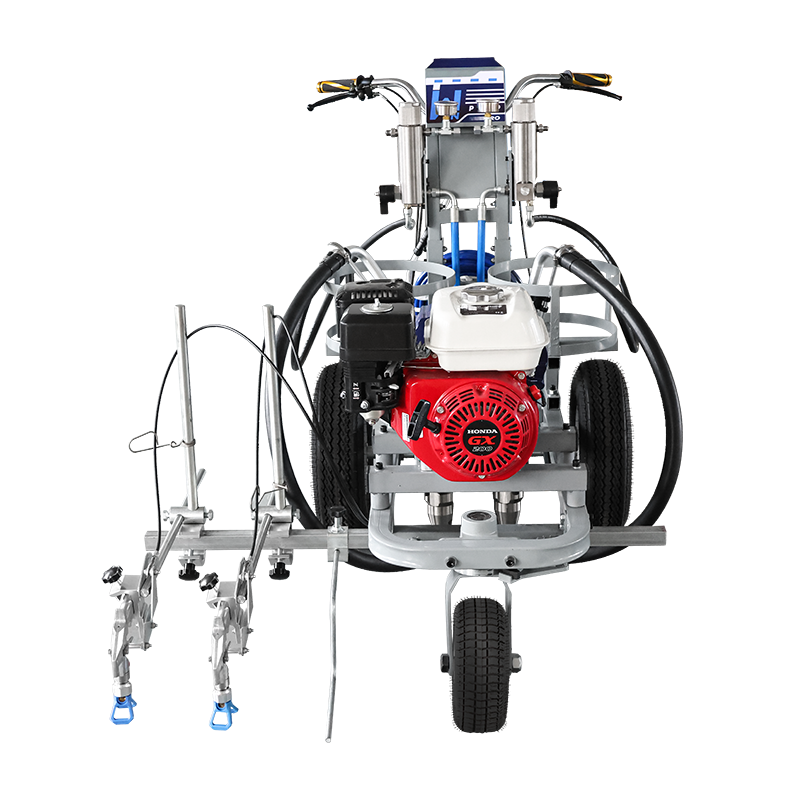
- HS50. Honda GX engine, aviation aluminium filter, 360-degree front wheel. Routine commercial lots and mixed surfaces.
- HS50-II. Electric, 3700 W at 3600 rpm, 8.8 L/min, 23 MPa. Large areas and dual-gun output.
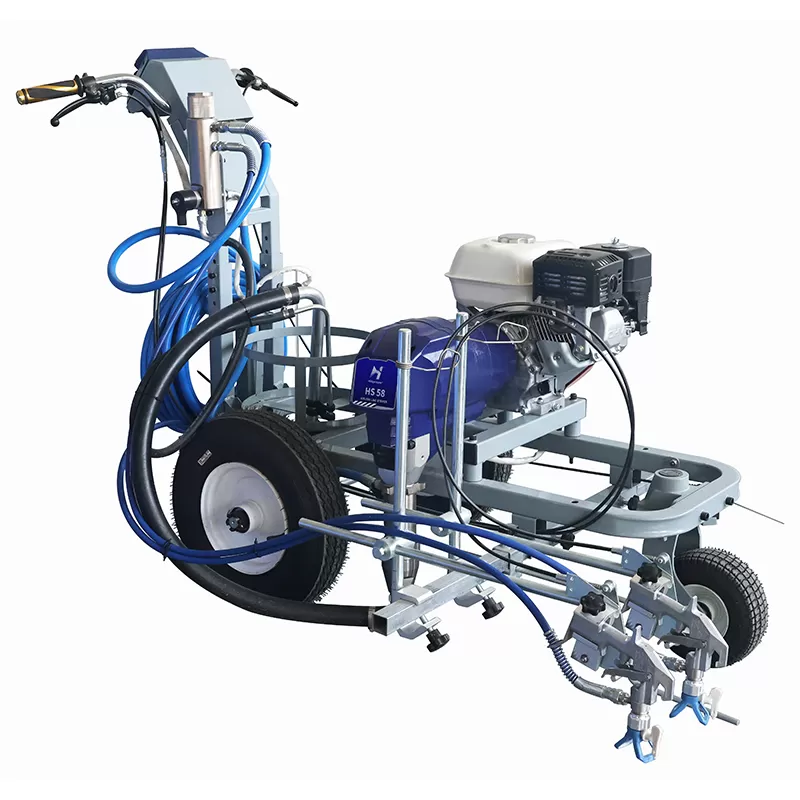
- H58. Electric, 3700 W at 3600 rpm, 5.8 L/min, 23 MPa. Indoor garages and steady mid-volume work.
Read that list as matching, not ranking. The right unit is the one whose flow, pressure, and weight fit the work you already have booked, not the one with the biggest number on the badge.
OEM and Dealer Checklist
Distributors and private-label buyers have a different list from contractors. These eight items decide whether a container arrives usable or sits in customs.
- Voltage and frequency: 110 V, 220 V, or 230 V, and 50 or 60 Hz.
- Plug and cable type for the destination market.
- Certification documents, with the exact standard named.
- Nameplate and manual language.
- Spare-parts kit and part numbers.
- Minimum order quantity and mixed-model rules.
- Lead time after deposit, in writing.
- Training material or a video walkthrough for the dealer's service team.
Ask for the test report for the exact voltage you ordered. A report for a different configuration is a common and expensive surprise at port.
Frequently Asked Questions
Q1: Can one parking line striping machine handle every lot?
A1: No. A small gas unit struggles on a 500-stall lot, and a large electric unit is wasted on 40-stall re-stripes. Match the machine to your annual stall volume and your largest single job, then keep a second unit only when the calendar justifies it.
Q2: Is gas or electric better for a first machine?
A2: Gas if your sites have no reliable power, if runs are long, or if you work in cold weather. Electric if most of your work is indoors, near homes, or on sites with a solid circuit. For a first machine on mixed work, gas removes the power question entirely.
Q3: How many jobs does it take to pay back the machine?
A3: Divide the price by the margin you keep per lot. A 3,000 dollar machine earning 500 dollars of margin per lot clears in six lots. Add paint, maintenance, and any finance cost before you call it paid, and compare the result with subcontracting the same work.
Q4: Can an airless striper replace thermoplastic equipment?
A4: No. Thermoplastic is applied molten at 180 to 220 degrees Celsius with a screed box or a hot-spray unit. Airless machines handle liquid coatings such as acrylic, solvent-borne paint, and epoxy. The two serve different specifications, not different budgets.
Q5: What should overseas buyers check before ordering?
A5: Voltage and frequency, plug type, certification for the destination market, spare-parts availability, and the test report for the exact configuration. Confirm the Incoterm and who handles customs. A short video call with the factory answers more than a page of specifications.
The six steps hold up across markets: define the job, pick the power source, compare pressure and flow, set the gun and line width, confirm paint compatibility, and plan for spares.
A parking line striping machine that fits the job pays for itself inside a season. One that does not becomes a storage problem with a warranty.
Send your lot sizes, surface type, and annual stall volume to HVBAN for a model recommendation, a full spec sheet, and a quote. If you are still deciding, ask for a video test stripe on your own paint and see the line before you commit.