
Bottom line: choose a floor paint striping machine by six decisions: surface, line width, paint chemistry, flow and pressure, power source, and maneuverability. The pump and tip decide the line quality; the paint only reveals it.
A warehouse aisle, a factory safety zone, and an outdoor parking lot do not need the same machine. The wrong choice shows up as fuzzy edges, thin coverage, clogged tips, or an operator who cannot keep a straight line after 200 meters.
This guide explains how airless line stripers work, compares the decisions that matter, and gives a practical model shortlist from HVBAN’s line striper range.
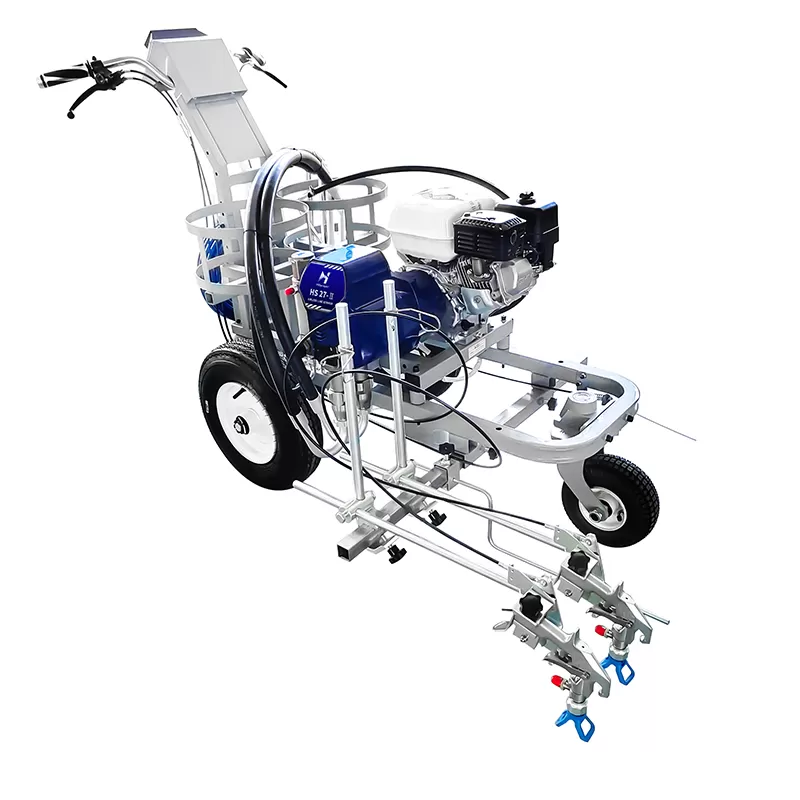
What a floor paint striping machine actually does
An airless line striper pressurizes paint and forces it through a small tip. The pressure atomizes the paint into a fan pattern, and the gun height and tip size set the line width.
The technical overview of road surface marking explains the broader function of line markings: guidance, allocation of space, and safety. Floor marking inside a building follows the same logic, with different paint and traffic.
- Pump: creates the pressure and flow needed for the tip.
- Tip: sets the line width and the paint fan.
- Gun and holder: keep the spray angle consistent.
- Wheels and frame: control straight-line tracking and operator fatigue.
- Power source: gas, electric, or another drive; it decides where the machine can run.
A striper is a system. A good pump with the wrong tip produces a bad line just as quickly as a weak pump.
Floor paint striping machine: six decisions
These six decisions should be settled before you compare models.
1. Surface and line layout
Concrete, asphalt, and sealed floors absorb paint differently. Indoor floors usually need a hard, clean, dry surface; outdoor asphalt may need a different paint and optional glass beads for retroreflectivity.
Measure the line width and the longest straight run. Long warehouse aisles reward a line driver; short, broken layouts reward maneuverability.
2. Paint chemistry
Water-based acrylic, solvent-based, and two-component epoxy behave differently in the pump. Two-component paint has a pot life; once mixed, it has to be sprayed and flushed within the working window.
Ask for the paint’s viscosity, solids, recommended tip size, and cure time. A machine that sprays one paint well may struggle with another. For a new marking material, ASTM D713 describes a road-service test practice that can help structure a field evaluation.
3. Flow and pressure
Flow is measured in liters per minute; pressure in MPa or bar. The tip needs enough flow at the right pressure to form a clean fan.
HVBAN lists the HS27-II at 5 L/min and 21 MPa, and the HS50-II at 8.8 L/min and 23 MPa. Higher flow supports wider lines or faster travel; higher pressure helps with viscous paint, but it is not a substitute for the right tip.
4. Power source
Gas engines suit outdoor sites and large areas without convenient power. Electric units suit indoor floors where ventilation and noise are controlled.
Check the available power, cable length, and ventilation. A gas unit indoors needs exhaust management; an electric unit needs a reliable supply.
5. Maneuverability and line tracking
Look at the front wheel, the gun position, and the line driver interface. A 360° self-adjusting front wheel helps the machine track a straight line; an adjustable gun holder lets the operator spray front, rear, or side.
For long runs, a line driver reduces fatigue and improves consistency. For tight layouts, a smaller frame and a shorter wheelbase are easier to control.
6. Productivity and labor
Calculate the daily meters, not only the machine speed. Preparation, masking, paint mixing, flushing, and drying usually take more time than the spray pass.
Ask how long a color change takes, how the machine is cleaned, and how many operators are needed. A faster pump does not help if the crew spends an hour cleaning it.
Surface, paint, and setting: a practical match
The table below is a starting point. Confirm the paint supplier’s data sheet before setting the machine.
| Surface | Typical paint | Setting focus |
|---|---|---|
| Warehouse concrete | Water-based acrylic or epoxy | Clean, dry floor; consistent line width; line driver for long aisles |
| Factory bay | Epoxy or two-component | Pot life, flush time, chemical resistance |
| Outdoor asphalt | Traffic paint, optional glass beads | Weather window, adhesion, retroreflectivity |
| Parking lot | Traffic paint or thermoplastic | Line layout, stencil work, traffic control |
A paint that is too thick for the tip will produce a thin, uneven line even at maximum pressure. A paint that is too thin may run or fail to cover.
Floor paint striping machine models: what changes
HVBAN’s range includes gas and electric line stripers. The table compares three models on the specifications published by the company.
| Model | Power | Max flow / pressure | Best for |
|---|---|---|---|
| HS27-II | 4.1 HP gas | 5 L/min / 21 MPa | Outdoor sites, medium-duty floor and road marking |
| HS50-II | 3700 W / 3600 rpm | 8.8 L/min / 23 MPa | Higher flow, wider lines, larger areas |
| H58 | 3700 W / 3600 rpm | 5.8 L/min / 23 MPa | Balanced flow and pressure for general line work |
Confirm the engine or electric configuration for the exact model and destination. The published power type can vary by build.
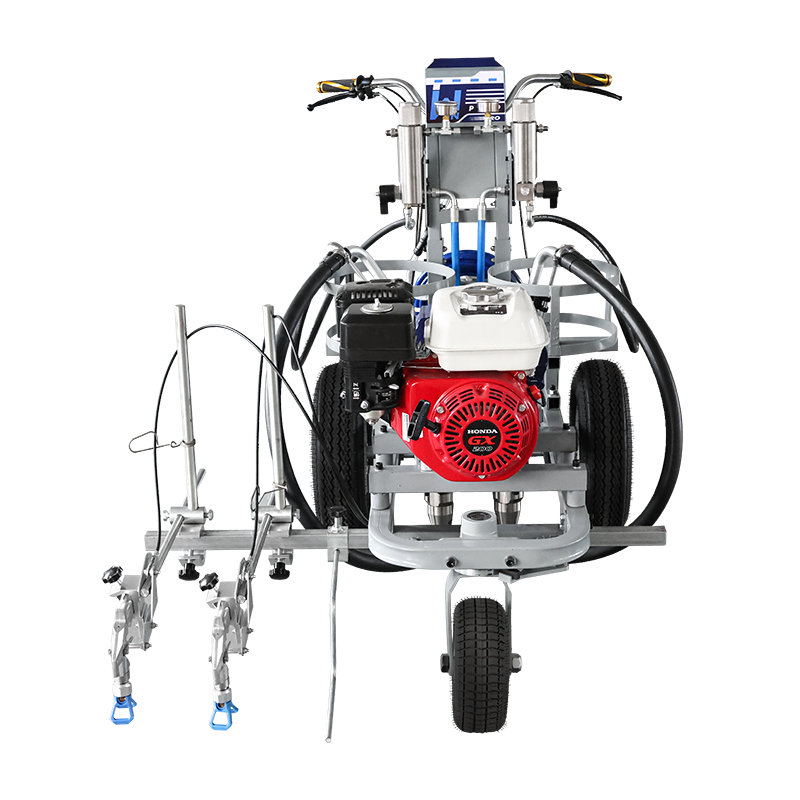
Which machine fits which job
Use these profiles to narrow the shortlist before the demo.
Warehouse and distribution center
Long, straight aisles and repeatable line widths matter. Prioritize a line driver, a stable front wheel, and enough flow for the line width.
Check the floor coating and the forklift traffic. A line that wears quickly costs more than a slightly slower machine.
Factory and production bay
Safety zones, walkways, and equipment boundaries often use epoxy or two-component paint. Prioritize pot life, flush time, and chemical resistance.
Plan the color changes and the cleaning area before the project starts.
Parking lot and outdoor pavement
Weather, asphalt texture, and traffic paint dominate. A gas unit is often practical where power is not available; glass beads may be added for retroreflectivity.
Check the surface temperature and the weather window. Fresh asphalt and cold pavement change adhesion.
Contractor and rental fleet
Transport, setup time, and service support matter as much as flow. A machine that is easy to train on and easy to maintain stays in service.
Ask for the manual, the parts list, and the service interval before you standardize a fleet.
Small shop and low-volume user
Short runs and occasional use may not justify a large unit. Prioritize maneuverability, cleanup time, and a clear line width.
Do not overbuy pressure you will never use; a smaller machine with the right tip can produce a better line.
Line quality: what to check in a demo
Bring your paint and your floor. A demo on a smooth concrete slab with the supplier’s paint is not a production test.
- Edge quality: sharp edges, no fuzzy overspray.
- Coverage: consistent film build across the line.
- Width: the line matches the specification after curing.
- Tracking: the machine holds a straight line over a long run.
- Speed: the crew can maintain the pace without skips.
- Cleanup: color change and flush time are acceptable.
- Fatigue: the operator can control the machine for a full shift.
Run the demo on the actual surface, at the actual line width, with the actual paint. That is the only test that matters.
Where HVBAN fits
Fuzhou HVBAN Mechanical Equipment Co., Ltd. manufactures airless paint sprayers and line stripers in Fuzhou, China. The company reports more than 20 years of experience, 300 staff, 40 patents, a 50,000 m² factory, and exports to more than 140 countries.
- HS27-II Airless Line Striper: 4.1 HP gas, 5 L/min, 21 MPa.
- HS50-II Airless Line Striper: 3700 W, 8.8 L/min, 23 MPa.
- H58 Airless Line Striper: 3700 W, 5.8 L/min, 23 MPa.
Ask about the pump configuration, tip size, line width, paint compatibility, power source, and demo plan. Those details decide whether the machine fits the floor. A quality management system such as ISO 9001 is a useful baseline for consistency, but the demo and the manual still matter.
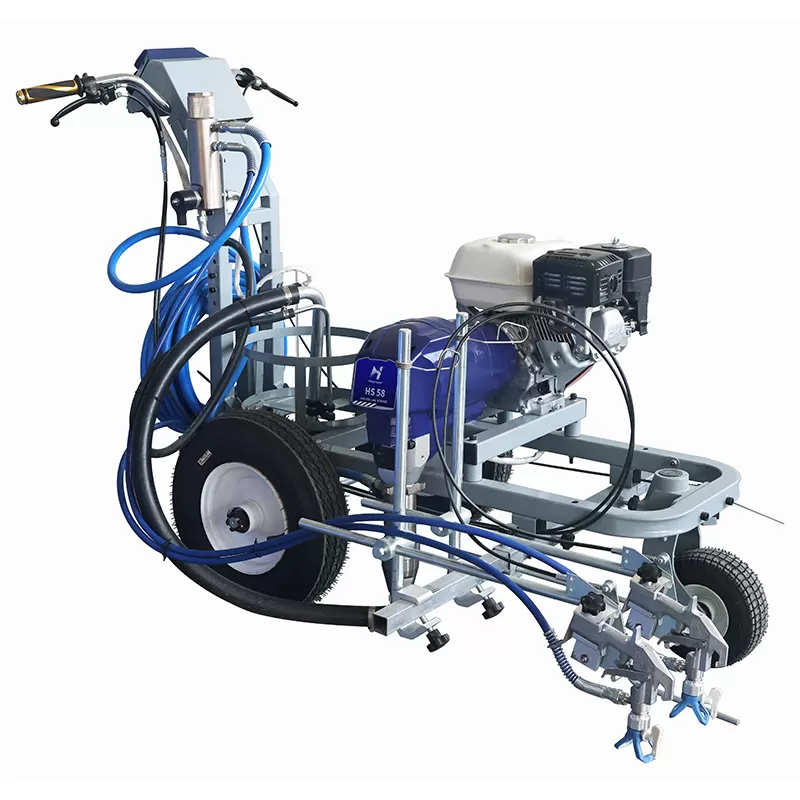
Common mistakes
Most bad line projects are decided before the machine arrives.
- Buying on pressure alone. Flow, tip size, and paint viscosity decide the line.
- Using the wrong paint. Two-component paint has a pot life; a standard pump setup may not match it.
- No line driver for long runs. Operator fatigue shows up as wavy lines.
- No surface prep. Dust, oil, and moisture cause adhesion failures.
- Testing on the wrong floor. A smooth demo slab is not the warehouse aisle.
- Ignoring cleanup. A machine that takes too long to flush costs production hours.
- No manual or service plan. A line striper is a long-term tool, not a one-job purchase.
A paint data sheet, a floor sample, and a demo prevent most of these problems.
Frequently asked questions
Q1: What is a floor paint striping machine?
A1: It is an airless sprayer mounted on a wheeled frame, used to apply paint lines on warehouse floors, factory bays, parking lots, and roads. The pump, tip, and gun set the line width and quality.
Q2: Gas or electric for indoor floor marking?
A2: Electric is usually easier indoors because there is no exhaust. Gas suits outdoor sites without power. Check ventilation, noise, and cable length before choosing.
Q3: What line width can I spray?
A3: Line width depends on the tip size and gun height. Ask the supplier to match the tip to your target width and paint, then confirm it in a demo.
Q4: Can I spray two-component epoxy?
A4: Some airless line stripers support two-component paint with the right pump and flush procedure. Confirm the pot life, the mix ratio, and the cleaning method with the paint supplier.
Q5: How do I choose between the HS27-II, HS50-II, and H58?
A5: Start with the surface, line width, paint, and daily meters. The HS27-II is gas-powered; the HS50-II offers higher flow; the H58 balances flow and pressure. Confirm the exact build before ordering.
Request a floor paint striping machine recommendation
A useful inquiry includes more than a request for a price. Tell the team what the floor needs and how the machine will be used.
- Surface type and condition.
- Line width and total meters per day.
- Paint type, viscosity, and pot life.
- Indoor or outdoor site; power available.
- Line driver, glass beads, or stencil requirement.
- Demo timing, destination, and service support.
Send those details to HVBAN and ask for a model recommendation and a demo plan. The right floor paint striping machine is the one that matches the surface, the paint, and the crew, not the one with the highest pressure number.
Sources and further reading
- Wikipedia: Road surface marking — a technical overview of line markings and their functions.
- ASTM D713: Standard Practice for Conducting Road Service Tests on Fluid Traffic Marking Materials — a practice for evaluating marking materials in service.
- ISO 9001:2026: Quality management systems — Requirements — the current edition of the quality management standard.