
Road striping and pavement maintenance contractors face tighter project timelines, stricter municipal standards, and rising labor costs. Choosing the right machinery directly affects your bid competitiveness and job-site margins. Whether you re-stripe suburban commercial parking lots or apply thermoplastic lines on state highways, your machinery dictates your daily linear footage.
Leading builders like Graco, Hofmann, Borum, and factory-direct innovators like HVBAN continue to introduce digital pressure controls, multi-material capabilities, and ergonomic drive systems. This guide reviews the market baseline for professional line stripers in 2026 to help you select the most profitable unit for your fleet.
Planning to upgrade your striping fleet this season? Contact our technical sales team today to request factory direct pricing, machine specifications, and international container freight rates.
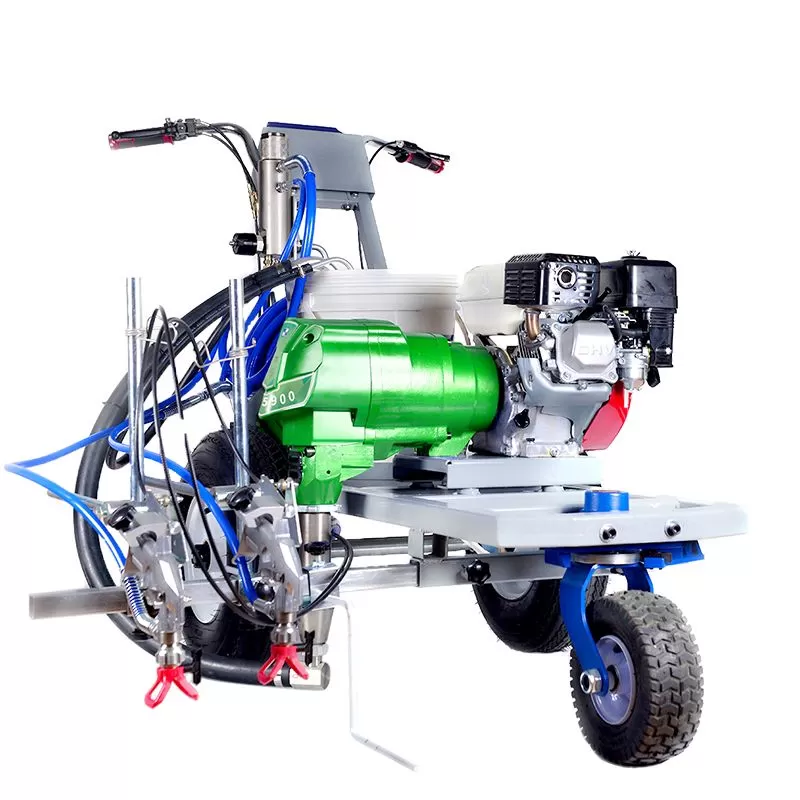
1. Core Pavement Marking Equipment Types in 2026
Striping applications vary widely by project specification, regional climate, and paint chemistry. Matching the applicator to your local project scope prevents premature equipment wear and costly paint application failures.
Airless Cold Paint Stripers
Cold spray line stripers remain the backbone of urban road work, parking lot maintenance, and airport taxiway layouts. These units use high-pressure hydraulic or mechanical piston pumps to atomize waterborne traffic paints, solvent-based paints, and light epoxies without air injection.
- Operating Pressure: 1,500 to 3,300 PSI for sharp, bleed-free edges.
- Best Use: Commercial parking facilities, city crosswalks, warehouse safety lines, and curbs.
- Key Advantage: Fast setup, quick cleanup, and low material preparation time.
Thermoplastic Road Marking Equipment
Municipal highway agencies demand thick, long-lasting lines that withstand snowplows and continuous heavy vehicle traffic. Thermoplastic machines melt solid hydrocarbon or alkyd resin blocks at temperatures exceeding 200°C (400°F), applying them via screed shoe, extrusion, or spray.
- Application Thickness: 1.5 mm to 3.0 mm (60 to 120 mils), often embedded with reflective glass beads.
- Support Needs: Requires pre-heaters mounted on transport flatbeds to continuously supply molten material.
- Best Use: Arterial roads, interstate highways, and high-wear intersection stop bars according to FHWA highway markings specifications.
Plural-Component and MMA (Methyl Methacrylate) Applicators
Two-component 98:2 or 1:1 MMA stripers mix liquid resin with a chemical catalyst right at the spray manifold or externally in the fan pattern. The resulting line cures by chemical reaction rather than evaporation.
- Service Life: Exceeds 3 to 5 years under extreme traffic loads.
- Cold Performance: Can be applied at lower pavement temperatures where waterborne paints fail to dry.
- Drawbacks: High initial equipment cost and unforgiving cleaning protocols; any mixed material left inside the manifold hardens permanently.
Push Units vs. Self-Propelled and Ride-On Systems
Small layout projects benefit from manual push units due to their agility around light poles and tight radii. However, any job exceeding 5,000 linear feet justifies a self-propelled hydrostatic drive or a ride-on sulky attachment.
Adding a sulky or buying a self-propelled chassis doubles linear production per shift and cuts operator fatigue. Contractors who transition from manual push stripers to motorized ride-on platforms routinely report a 30% reduction in labor hours on large commercial parking pads.
2. 2026 Top Pavement Marking Machine Manufacturers Reviewed
Selecting the right equipment manufacturer requires balancing initial purchase cost, parts availability, build quality, and local dealer support.
Graco (United States)
Graco continues to lead the airless market with their established LineLazer family. Contractors across North America rely on their continuous-duty hydraulic pumps and electronic pressure controls.
- Core Strengths: Exceptional build quality, reliable Honda power plants, widely available aftermarket packings, and strong resale value.
- Flagship Models: LineLazer V 3900 (parking lots and intermediate municipal work) and LineLazer V 200HS (high-output, heavy-viscosity road paint).
- Drawback: High initial purchase price and premium costs for proprietary accessories.
Hofmann (Germany)
Hofmann manufactures heavy-duty, self-propelled, and truck-mounted road marking platforms. They are widely considered the benchmark for European autobahn applications and high-speed airport runway projects.
- Core Strengths: Extreme engineering precision, automated line-gap control electronics, and massive hopper capacities.
- Flagship Models: H-series ride-on marking machines capable of handling cold paints, thermoplastics, and structural MMA in a single chassis.
- Drawback: Excessive capital investment for local parking lot contractors; steep operational learning curve.
Borum (Denmark)
Borum focuses on mid-to-large-scale highway equipment. Their Master series offers customized, multi-material platforms that integrate screed, extrusion, and paint spray systems on rigid chassis configurations.
- Core Strengths: Modular design allow operators to configure thermoplastic and cold spray setups on the same base vehicle. Excellent operator comfort and ergonomic line-of-sight.
- Flagship Models: Borum Master 2000 and 3000 series.
- Drawback: Long lead times for factory parts delivery outside the European market.
HVBAN (Factory-Direct / High ROI Solution)
Contractors seeking professional performance without standard dealer markups increasingly source equipment from factory-direct manufacturers. HVBAN specializes in high-output airless pavement stripers engineered with heavy fluid sections and hydraulic pump assemblies built to handle dense commercial paints.
- Core Strengths: Direct factory pricing, robust hydraulic fluid sections, universal component compatibility, and responsive OEM technical support.
- Primary Applications: Commercial parking lot stripers, school zone marking, local road maintenance, and athletic field contractors.
- Drawback: Requires contractors to maintain direct communication with the manufacturer rather than relying on a local street-corner dealership.
3. Five Critical Factors to Evaluate Before Purchasing
Avoid buying based on engine horsepower alone. Match technical machine capabilities to your regional materials, crew experience, and expected maintenance capabilities.
Fluid Section Durability and Pump Style
Mechanical diaphragm pumps work well for light-duty, periodic striping using standard water-based paints. However, commercial operations spraying high-viscosity traffic latex, chlorinated rubber, or solvent paint need a slow-stroking, heavy-displacement hydraulic piston pump.
Chrome-plated or ceramic-coated pump rods resist the abrasive effects of quartz fillers and heavy pigments found in municipal-grade road paints, substantially lengthening packing life.
Application Precision and Bead Delivery Systems
High paint thickness does not guarantee highway compliance. Markings require uniform retroreflectivity, which depends on consistent glass bead distribution into the wet paint binder. High-grade equipment features pressurized bead tanks with dual-dispenser guns linked to the drive speed.
Review the compliance requirements established by the American Traffic Safety Services Association (ATSSA) to ensure your bead-drop mechanism and binder mil-thickness meet standard roadway safety regulations.
Guidance Systems and Automatic Layout Modules
Marking a new parking lot or municipal road layout manually wastes valuable operating hours. Modern high-output stripers offer:
- Green Laser Pointers: High-visibility daytime lasers that track reference chalk lines or pavement seams.
- Electronic Skip-Line Controllers: Solenoid-actuated gun controls that program cycle lengths (for example, 10 feet of paint followed by 30 feet of space) automatically using wheel encoders.
Engine Reliability and Drive Train
Road stripers operate under heavy vibrations, high ambient temperatures, and continuous stop-and-go conditions. Look for commercial engines like the Honda GX series, paired with hydrostatic variable-speed transmissions.
Hydrostatic drives provide smooth speed adjustments without clutch wear, ensuring uniform paint film thickness across uphill slopes and uneven road surfaces.
Parts Availability and Job-Site Serviceability
When a spray gun valve jams or an intake packing fails at 2:00 AM on a shopping center restripe, you cannot wait three days for a custom fitting. Select machines built with industry-standard spray tips, common gun threads, and standard fluid filters that your mechanics can source locally.
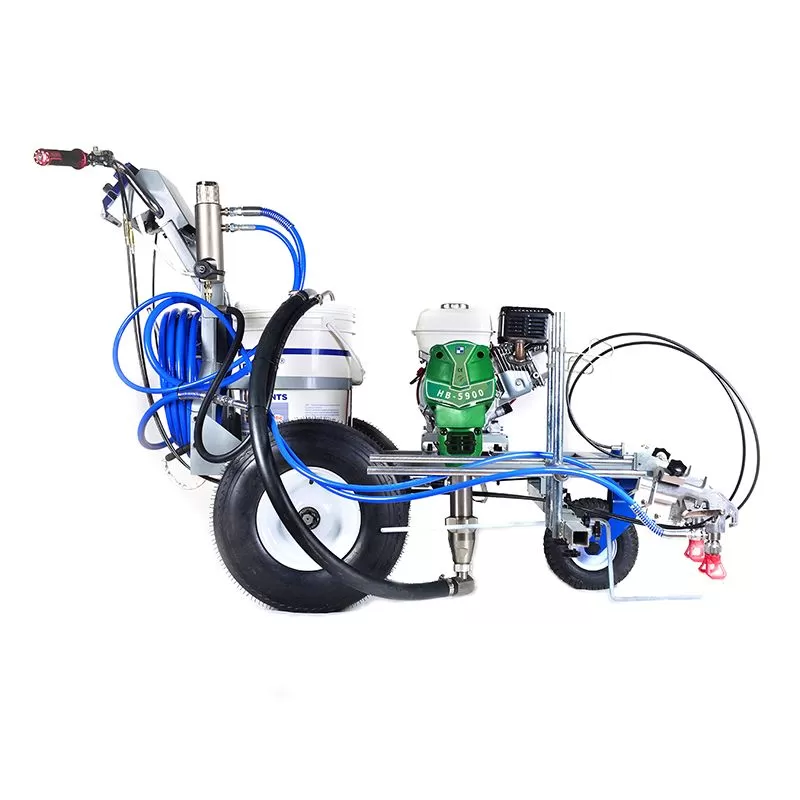
4. Cost Analysis and Expected ROI in 2026
Investing in commercial line striping machines for sale requires a clear understanding of capital costs versus ongoing labor savings. The table below outlines 2026 baseline prices across different equipment categories:
| Machine Category | Typical Price Range (USD) | Daily Output Potential | Target Contractor / Application |
|---|---|---|---|
| Entry Push Airless Striper | $3,500 - $6,500 | 3,000 - 8,000 linear ft | Property maintenance, sports courts, small parking lots |
| Professional Self-Propelled / Sulky Rig | $9,500 - $18,000 | 15,000 - 40,000 linear ft | Commercial striping contractors, town DPWs |
| Manual Thermoplastic Hand Applicator | $4,000 - $8,500 (excl. melter) | 2,000 - 5,000 linear ft | Intersection bars, pedestrian crosswalks, legends |
| Self-Propelled Plural / Thermoplastic | $45,000 - $120,000 | 30,000 - 80,000 linear ft | Major road contractors, state highway contractors |
| Truck-Mounted Striping Rig | $160,000 - $450,000+ | 100,000+ linear ft | State DOTs, specialized highway barrier stripers |
Calculating the true return on investment (ROI) involves measuring labor reductions against machine payments. For example, upgrading from a standard walk-behind unit to a ride-on, dual-gun hydraulic system like the HVBAN SP-series allows a two-person crew to stripe an 800-stall distribution warehouse lot in one night instead of two.
Saving an entire night of crew wages, fuel, and perimeter traffic control costs recovers the machine's initial capital expenditure over the course of four to six large commercial projects.
5. Frequently Asked Questions (FAQ)
Q1: Which striper is best suited for commercial parking lot layout?
A1: A single or dual-gun airless cold paint striper equipped with a swiveling front wheel is ideal for parking lots. It navigates tight turns around curbing and parking stalls effortlessly. A slow-stroking hydraulic pump delivers steady pressure to ensure sharp line edges without paint overspray.
Q2: Do I need an external pre-heater when purchasing a thermoplastic hand machine?
A2: Yes. Manual thermoplastic screed machines have small burners designed solely to keep pre-melted material hot while you work. They lack the heating capacity to liquefy raw thermoplastic blocks from room temperature. You need an auxiliary single or double-tank pre-heater mounted on a transport truck to feed the hand machine.
Q3: What is the typical lead time and shipping process for importing pavement marking equipment?
A3: Factory-direct equipment imports take between 20 to 45 days depending on standard sea-freight routes and local customs processing. Industrial machines ship securely in reinforced wooden crates with hydraulic fluid drained to meet international freight handling regulations.
Q4: How does a hydraulic piston pump compare to a mechanical diaphragm pump in road stripers?
A4: Hydraulic piston pumps operate with a much longer stroke at lower cycle rates, reducing friction and packings wear when pumping abrasive traffic paints. Mechanical diaphragm pumps cycle constantly at higher speeds, making them prone to diaphragm tearing and pressure drops when using heavy, viscous paints.
Q5: Can standard cold paint airless line stripers shoot reflective glass beads automatically?
A5: Standard units require an add-on gravity or pressurized bead dispenser kit. Pressurized systems connect directly to an air tank or mechanical drive to release glass spheres onto wet paint within one second of application, meeting state reflectivity standards like those set by AASHTO.
Final Buying Recommendations
Upgrading your striping machinery in 2026 demands careful consideration of your primary project profile. If your company focuses on municipal street maintenance and highway intersections, investing in thermoplastic equipment or high-pressure plural-component sprayers is essential.
If your workload centers on property management, logistics centers, city streets, and parking decks, a heavy-duty hydraulic airless striper offers the highest return on capital. Manufacturers like HVBAN provide professional-grade hydraulic striping platforms directly from the production facility, giving your business reliable field performance without inflated distributor costs.
Ready to purchase new pavement marking equipment?
Contact our engineering and sales department today to request comprehensive equipment catalogs, receive custom machine build quotes, and discuss global freight options for your business.