
Choosing the wrong striping rig can drain your profit margins before the first job wraps up. Paint pooling, fuzzy line edges, and persistent mechanical downtime cost road contractors thousands of dollars each season. Selecting the right striping platform directly dictates your material consumption, labor efficiency, and overall compliance with local traffic standards.
Two primary fluid displacement technologies dominate the liquid striping sector: high-pressure airless spraying and conventional air atomization. While both systems apply road striping paints, they operate on opposing fluid mechanics and serve vastly different project demands. Leading manufacturers like HVBAN engineer specialized solutions around these core technologies to handle distinct application environments.
Whether you manage commercial parking stalls or stripe dozens of highway miles every night, this technical breakdown evaluates which pavement marking equipment delivers the highest return on investment for your daily scope of work.
Planning to upgrade your road striping fleet this season? Submit an inquiry to the HVBAN technical team for tailored equipment configurations and competitive factory pricing.
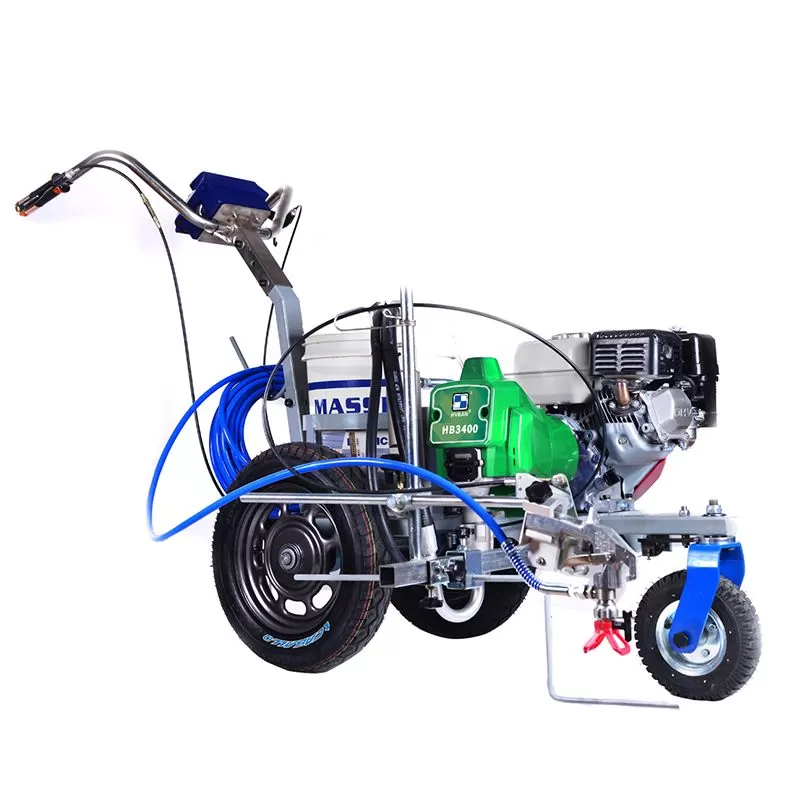
Understanding the Technology: How Airless and Air Spray Work
Before evaluating operating costs and line aesthetics, you must understand the mechanical differences between fluid pressurization and pneumatic atomization.
What is Airless Pavement Marking Equipment?
An airless line striper forces high-viscosity traffic paint through a specialized tungsten carbide spray tip under extreme hydraulic or mechanical pressure—typically between 1,500 and 3,300 PSI. The system does not mix air into the fluid path.
When the paint exits the small orifice of the tip, the abrupt drop from hydraulic pressure to atmospheric pressure shears the liquid into a finely atomized, high-velocity fan. This continuous sheet cuts cleanly through surface turbulence, delivering paint straight into the voids of rough asphalt.
- Operates without an atomizing air compressor directly in the fluid line.
- Supports high-solid waterborne and solvent-based paints without excessive thinning.
- Creates dense film builds and crisp, razor-sharp edges on flat asphalt and concrete.
What is Air Spray Road Marking Equipment?
An air spray road marking machine relies on low fluid pressure (typically 30 to 80 PSI) paired with a high-volume stream of compressed air. Paint feeds into a specialized spray gun where an external or internal air stream hits the liquid stream, breaking the paint into droplets via pneumatic shearing.
This process follows standard industrial fluid atomization dynamics, producing soft spray patterns with gentle transition zones at the edges. Air spray setups require dedicated air compressors with large CFM ratings to continuously feed the paint guns and bead dispenser nozzles.
- Uses low liquid pressure combined with high-volume compressed air (CFM).
- Requires thinner coatings or heated tanks for heavy traffic paints.
- Allows micro-adjustments to atomizing air pressure to control spray feathering.
Head-to-Head Performance Comparison
Evaluating striping machines requires comparing how each technology handles paint delivery, line sharpness, job speed, and overspray control on genuine road substrates.
| Performance Metric | Airless Striping Equipment | Air Spray Striping Equipment |
|---|---|---|
| Operating Fluid Pressure | 1,500 – 3,300 PSI | 30 – 80 PSI (with high-CFM air) |
| Edge Sharpness | Razor-sharp borders, minimal feathering | Slightly softer edges, possible misting |
| Coating Viscosity Handling | Pumps undiluted, heavy-solid traffic paints | Often requires paint reduction or fluid heating |
| Overspray Control in Wind | High-velocity spray cuts through moderate wind | Susceptible to side-wind drift and paint loss |
| Application Speed | Up to 10–14 mph on motorized chassis | Up to 15–20 mph on highway truck platforms |
| Equipment Maintenance | Fast fluid section flushes; tip wear checks | Multiple air lines, fluid pots, and needles to clean |
Line Sharpness and Definition
For crisp line edges, airless systems win decisively on smooth-to-medium aggregate surfaces. The high-velocity impact of an airless spray fan plants paint directly onto the substrate before droplets can drift. This produces distinct demarcation lines that easily satisfy ASTM D713 standards for visual edge sharpness and road durability.
Air spray systems introduce substantial turbulence at the spray gun tip. The compressed air stream scatters microscopic paint particles outward along the spray pattern perimeter, leading to a softer, slightly feathered edge unless you install mechanical wind shrouds or sulky discs.
Application Speed and Efficiency
Airless units excel in single-line and dual-line productivity for short to medium runs. Because they spray thick paints without dilution, airless machines leave high dry-film thicknesses in a single pass. Operators move quickly without worrying about solvent evaporation delays.
Industrial air spray setups pull ahead in continuous, long-distance straight runs. Long-line striping trucks utilize massive air compressors and pressure pots holding hundreds of gallons of paint. They can spray up to 20 miles per hour, making pneumatic atomization a historical favorite for open highway striping operations.
Paint Compatibility and Overspray Waste
Environmental standards increasingly limit volatile organic compounds (VOCs). Consequently, heavy-bodied waterborne traffic paints have replaced solvent paints in many districts. Airless piston pumps pull these viscous, quick-drying formulas straight from 5-gallon pails or 55-gallon drums without thinning.
Air spray guns struggle with heavy, unthinned waterborne paints. If you drop the viscosity with water or solvent to make it atomize via air, you risk paint running, slow cure cycles, and premature wear. Furthermore, the high volume of exhaust air from pneumatic guns creates significant overspray, blowing up to 15% of your paint into the atmosphere on breezy days.
Maintenance and Daily Clean-Up
Maintenance overhead directly impacts your daily labor bill. A walk-behind airless system contains a streamlined fluid passage: a pick-up tube, an internal piston pump cylinder, a high-pressure hose, and a spray gun. Flushing takes under ten minutes using an appropriate solvent or water rinse.
Air spray setups involve pressurized fluid vessels, complex air caps, dual fluid-air fluid hoses, and multiple metering needle valves. Cleaning an air atomization rig demands thorough flushing of both pressurized fluid lines and air atomizing caps to prevent dried paint buildup from distorting the spray fan.
Matching Pavement Marking Equipment to Your Project Scale
Equipment suitability depends on your target operating environment. Purchasing an oversized rig drains your liquid capital, while under-equipping your crew triggers premature pump wear and slow turnaround times.
Small-Scale: Parking Lots, Curbs, and Commercial Properties
Commercial parking lots require maneuverability, tight radius work, and crisp paint boundaries against fresh sealcoating. Operators constantly start, stop, turn around parking bumpers, and paint custom stencils.
A compact, walk-behind road marking equipment for parking lots built on an airless platform is ideal here. Walk-behind airless units turn on a dime, fit inside standard utility trailers, and give operators clear visibility over front-mount guide wheels.
- Recommended Configuration: Push or mechanical-drive walk-behind airless striper.
- Key Advantage: Sharp stencil spraying using a detachable hand gun, zero air hose clutter, and fast color swaps.
- Target Projects: Schools, shopping centers, retail strip malls, parking garages, and athletic courts.
Medium-Scale: Municipal Roads, Intersections, and Industrial Campuses
Municipal street work presents diverse challenges: long continuous centerlines, frequent intersection stop bars, crosswalk ladders, and turn arrows. Crew efficiency hinges on carrying sufficient paint volume while retaining responsive steering.
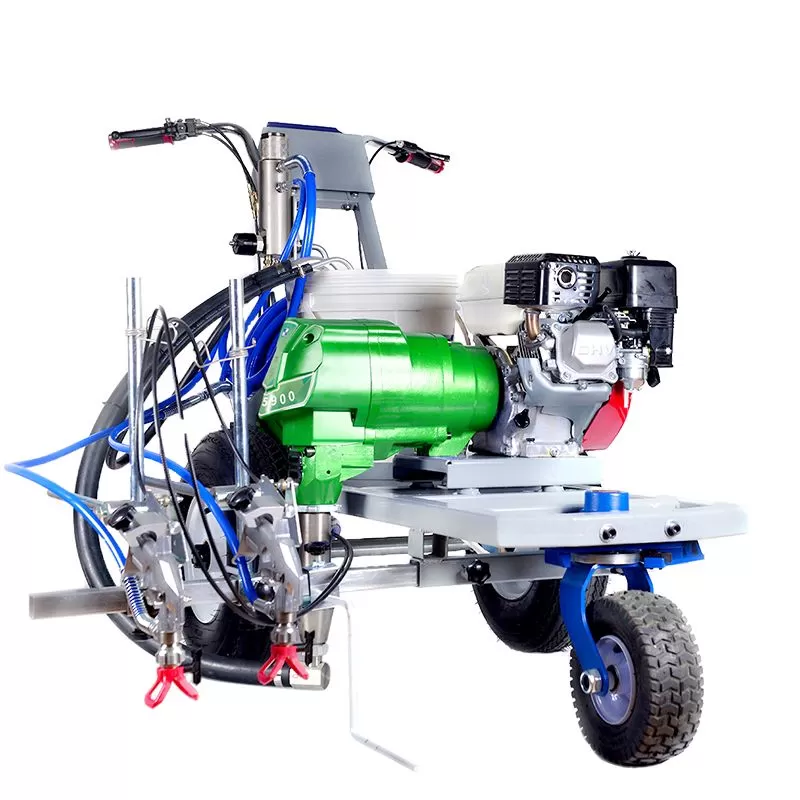
Contractors tackling city road projects benefit from self-propelled airless rigs or units paired with a ride-on sulky attachment. Reliable machinery, such as the mid-tier line stripers from HVBAN, offers consistent electronic pressure control, ensuring uniform wet-film application regardless of slight speed variances across pedestrian crossings and city blocks.
- Recommended Configuration: Self-propelled ride-on airless line striper with single or dual auto-layout guns.
- Key Advantage: Balances speed on straight city streets with agile manual operation around roundabouts and intersections.
- Target Projects: Municipal streets, warehouse floors, university campuses, and county arterials.
Large-Scale: Highways, Expressways, and Airport Runways
Highways and airport runways demand massive daily paint output, multi-line synchronization, and strict retroreflectivity specs mandated by the FHWA Manual on Uniform Traffic Control Devices (MUTCD). Striping crews must complete miles of highway restriping within strict nighttime traffic closures.
This scale requires heavy-duty machinery. Contractors rely on truck-mounted airless systems or large-displacement pneumatic air spray rigs. These setups feature automated bead gun timing, pressurized glass bead systems, and heated fluid lines that maintain high gallon-per-minute (GPM) ratings over miles of non-stop striping.
- Recommended Configuration: Truck-mounted continuous air spray or high-output dual-pump airless platforms.
- Key Advantage: Exceptional operational speeds, multi-gun indexing (yellow and white simultaneously), and giant fluid payloads.
- Target Projects: Interstate highways, multi-lane state routes, and international airport runways.
Cost Analysis: Upfront Price vs. Long-Term ROI
Initial purchase figures only represent a portion of your actual life-cycle expenditure. Smart fleet managers weigh equipment acquisition costs against paint consumption, crew labor hours, and maintenance parts.
Entry-level walk-behind airless equipment generally carries a competitive road marking machine price, running anywhere from $3,500 to $12,000 depending on drive motors, pump displacement, and automated line driver features. High-end pneumatic air spray trucks or specialized multi-color thermoplastic and cold-spray trucks regularly exceed $80,000 to $250,000.
Consider the practical factors driving your long-term return on investment:
- Paint Transfer Efficiency: Airless systems transfer approximately 85% to 90% of your paint directly to the road surface. Pneumatic air spray systems lose significant paint volume to atomized misting and wind deflection. Over 1,000 gallons of paint, airless equipment saves substantial material costs.
- Labor Output: Self-propelled ride-on attachments double your daily linear foot production compared to manual push rigs. This lets a two-person crew complete jobs that formerly demanded four crew members.
- Component Lifespan: Airless piston pumps contain hardened
chrome rods and carbide balls that withstand abrasive traffic paints. When wear
occurs, replacing a drop-in fluid section gets your rig back online within
thirty minutes.
Essential Buying Checklist for Striping Contractors
Review this checklist before placing an equipment deposit to guarantee your machinery matches your true field requirements:
- Primary Coating Type: Do you spray heavy-bodied, low-VOC waterborne traffic paint, fast-dry solvent, or plural-component methyl methacrylate (MMA)? Ensure pump packings and valves resist your specific chemicals.
- Daily Linear Footage: Estimate your average shift mileage. Projects requiring less than 15,000 linear feet favor nimble walk-behind airless units; runs exceeding 50,000 linear feet demand ride-on or truck systems.
- Bead Dispensing Needs: Will your project undergo immediate traffic release? If so, select a striper with an integrated, pressurized bead dispenser system to guarantee compliance with retroreflectivity specifications.
- Chassis Modularity: Can your chosen push machine integrate with a ride-on sulky later, or does it feature dual-gun mounts for simultaneously spraying double solid lines?
- Manufacturer Support: Does the brand provide accessible schematics, replacement fluid seals, and responsive warranty backing? Robust systems engineered by brands like HVBAN emphasize fast replacement part sourcing to keep you working during peak season.
Frequently Asked Questions (FAQ)
Q1: Can I use standard architectural paint sprayers for professional
pavement marking?
A1: No. Architectural sprayers
lack the abrasive-resistant fluid components, specialized pressure ranges, and
vibration-damped rolling chassis required for pavement paints. Traffic paints
contain high concentrations of coarse mineral pigments like silica and titanium
dioxide that ruin domestic spray pumps within hours. Dedicated pavement marking
equipment features hardened fluid sections and specialized tip geometry designed
to resist premature erosion.
Q2: Why do highway crews still use air spray machines if airless is
more efficient?
A2: Highway applications prioritize
rapid vehicle travel speeds and high material throughput over pinpoint edge
sharpness. Industrial air spray striping trucks handle immense volumes of paint
through non-restrictive fluid passages. They work reliably at 15 to 20 miles per
hour, where high-pressure airless tips might clog or wear quickly under
continuous, heavy aggregate flow.
Q3: How often do airless line striping spray tips need
replacement?
A3: A standard tungsten carbide
reversible line striping tip typically lasts between 300 and 600 gallons of
waterborne traffic paint. As tips wear, the orifice widens and the fan angle
narrows. This deposits thicker paint in the center of the line, wastes material,
and creates rounded edges. Inspect your line widths daily to catch tip wear
early.
Q4: Can an airless pavement marking machine spray reflective glass
beads?
A4: Yes, but beads are never mixed into the
paint pump. Road marking machines use a secondary glass bead dispensing system.
A gravity-fed or pressurized bead hopper mounts behind the paint gun, dropping
beads onto the wet paint within a fraction of a second so they embed partially
before the paint skins over.
Q5: What safety hazards are associated with high-pressure airless
road marking rigs?
A5: The primary hazard is fluid
injection injury caused by operating pressures exceeding 2,000 PSI. Operators
must never clear a spray tip with their fingers or place hands in front of the
gun while pressurized. Always engage the mechanical trigger lock and bleed fluid
pressure completely before servicing filters, hoses, or spray tips.
Choose the Right Machine for Your Job Scale
No single technology fits every line striping contract. For high-production municipal highway work, industrial air spray systems maintain continuous velocity across extended routes. For parking stalls, city crosswalks, airfields, and regional roadways, airless pavement marking equipment stands out for its high edge clarity, low overspray, and broad paint compatibility.
HVBAN builds professional-grade airless striping machinery engineered to handle abrasive coatings, continuous job site vibration, and demanding daily schedules. Our machines maximize your transfer efficiency, preserve your material budget, and deliver crisp lines from the first parking stall to the final stop bar.
Ready to configure the ideal machine for your striping business? Contact the HVBAN sales team today to request detailed equipment catalogs, technical data sheets, and custom distributor quotes.