
Drywall skimming and masonry surface preparation represent significant labor allocations on modern commercial jobsites. Traditional hand troweling demands extensive physical effort and produces variable film thickness across large wall areas. Transitioning to a heavy-duty airless spray plaster machine shifts commercial surface finishing toward higher mechanical output, consistent fluid delivery, and uniform leveling. Understanding the pump engineering, fluid properties, and operational parameters behind these systems allows contractors and facility managers to match machinery precisely to site requirements.
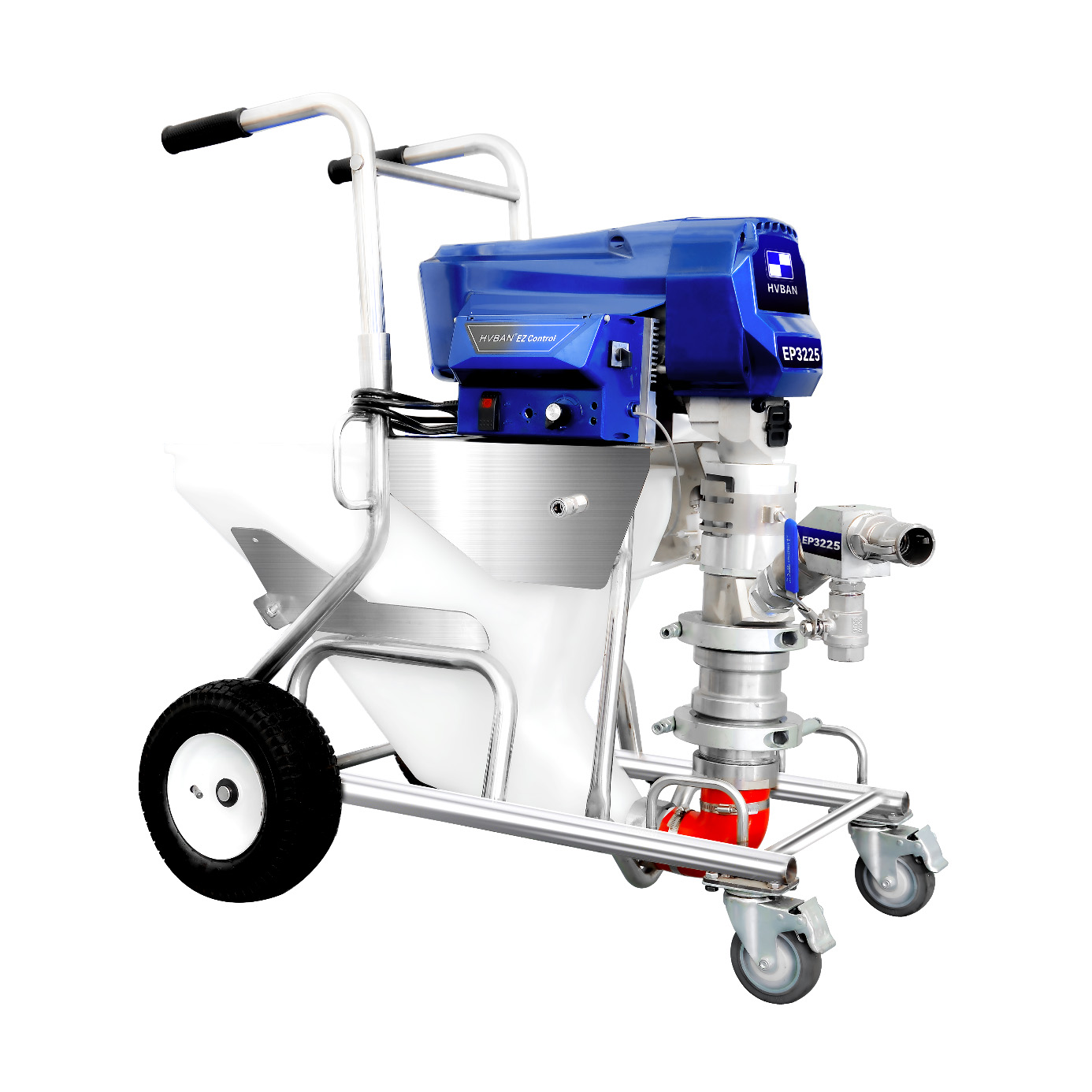
Fluid Dynamics and Mechanical Construction of Plaster Spray Units
High-viscosity architectural compounds behave differently than standard architectural coatings. Ready-mixed skim coats, airless joint compounds, and synthetic plasters display thixotropic properties. Under static conditions, these materials resist movement. When subjected to mechanical shear inside an oversized pump manifold, their apparent viscosity drops, allowing fluid movement through high-pressure lines.
Generating the mechanical force needed to atomize high-solids plaster without compressed air requires substantial hydraulic or direct mechanical drive systems. Unlike standard paint sprayers, an airless spray plaster machine operates with larger intake valves, extended fluid displacement sections, and reinforced packings designed to manage high friction. Displacement pumps feature an elongated piston stroke that runs at lower cycle frequencies. Slower cycling minimizes thermal expansion within the packings, reduces cavitation, and maintains steady delivery rates at the spray tip.
Intake design plays a defining role in fluid ingestion. Plaster spraying equipment relies on submerged or gravity-fed foot valves positioned directly inside the material container. Submerged suction minimizes inlet restrictions, allowing high-density pastes to enter the lower cylinder without forming vacuum pockets that cause pressure loss and erratic fan patterns.
Managing Viscosity: Material Characteristics and Pressure Requirements
Pumping heavy finishing compounds requires a balanced relationship between fluid pressure and flow volume. Spraying dense skim coats typically requires operating pressures between 200 and 230 bar (2900 to 3300 psi), paired with flow rates exceeding 6 to 8 liters per minute.
Filler Aggregate Particle Size: Plaster formulations contain mineral fillers such as calcium carbonate, talc, or mica. The internal fluid passages, manifold filters, and nozzle orifices must be sized larger than the maximum grain diameter to prevent blockages.
Shear Rates and Fluid Passages: Narrow internal elbows and restricted manifold ports cause material packing and pressure drops. Fluid sections engineered by manufacturers such as HVBAN incorporate streamlined fluid paths and enlarged ball-check cavities to ensure unhindered material velocity.
Frictional Drag in Hoses: Transporting dense compound over 30 to 60 meters creates fluid resistance along the inner hose wall. To minimize pressure loss between the pump and the applicator, lines use stepped hose systems—starting with a 1/2-inch internal diameter main line and reducing to a 3/8-inch whip hose near the gun.
Operational Efficiencies in Large-Scale Commercial Skimming
Applying base coats and finishing coats by hand creates variance in layer thickness, requiring extended sanding times to achieve Level 5 drywall standards. Mechanical spraying deposits a uniform wet film across ceilings and tall partition walls in a single pass.
In high-volume commercial projects, a three-person team utilizing a dedicated spray system alters production rates. One operator manages the spray gun, maintaining a continuous perpendicular sweep across the wall, while two workers follow immediately behind with wide skimming blades (ranging from 600mm to 1000mm) to smooth the compound. This method covers between 800 and 1500 square meters per working shift—substantially faster than traditional hawk-and-trowel methods.
Material utilization also improves. Hand application frequently leads to floor drop and compound waste during pan-to-wall transfers. Direct pumping from 80-liter hoppers or directly from pre-mixed drums delivers compound onto the substrate with minimal transfer loss, keeping the workspace cleaner and reducing cleanup labor.
Key Components Determining Longevity and Output Consistency
Pumping abrasive mineral mixtures causes continuous wear on internal components. Machinery longevity depends on base metallurgy, heat treatment, and tolerance design.
Displacement Piston Rods and Cylinder Liners
The piston rod experiences constant friction against the upper and lower packing sets. Standard carbon steels degrade quickly under contact with abrasive fillers. Commercial units utilize high-grade stainless steel rods coated with industrial hard chrome, ceramic layers, or titanium carbonitride treatments. These micro-smooth coatings resist scoring, extend packing lifespan, and prevent material bypass during pressure strokes.
Valve Seats and Ball Checks
The lower intake valve and upper piston valve must seal completely on every stroke cycle. Plaster particles caught between a valve ball and its seat prevent total closure, causing pressure drop. High-durability equipment utilizes tungsten carbide valve seats and high-density carbide or ceramic check balls. Equipment engineered by HVBAN utilizes chrome-plated pistons and hardened alloy valve seats to withstand the continuous hammering impact of high-viscosity materials.
Nozzle Geometry and Reversible Tip Sizing
Atomization takes place at the tungsten carbide spray tip. Spraying heavy compound requires tip orifices ranging from 0.035 inches up to 0.053 inches, depending on compound density and desired film build. Reversible tip designs allow the operator to clear occasional clogs by rotating the nozzle 180 degrees and cycling the trigger, clearing blockages without disassembling the gun assembly.
Daily Setup, Prime Cycles, and Maintenance Protocols
Operating an airless spray plaster machine across demanding schedules requires systematic setup, flushing, and lubrication protocols to maintain mechanical efficiency.
Initial Wetting and Priming: Dry packings overheat quickly if cycled without lubrication. Before introducing plaster, the fluid section requires initial lubrication with throat seal liquid (TSL). Priming starts with clean water or an approved solvent to wet the intake cylinder and verify valve movement before drawing compound into the pump.
Pressure Calibration: Operators must adjust the pressure control valve to the lowest setting that achieves full atomization without tailing or fingering at the edges of the spray fan. Running at excessive pressure accelerates tip wear, increases overspray, and places unnecessary load on the motor and drive gearbox.
In-Line Filtration Management: While standard paint sprayers use fine 60-mesh or 100-mesh manifold filters, heavy plaster applications require coarser mesh screens (such as 30-mesh) or complete removal of the manifold filter to allow aggregate flow, relying entirely on the gun handle filter or tip guard.
Shutdown and Flushing Procedures: Leaving compound inside the pump overnight causes plaster to set, locking the piston rod and damaging the packings upon restart. Post-operation flushing requires circulating water through the fluid section until the discharge runs clear, followed by running a storage fluid through the system to prevent internal oxidation.
Common Mechanical Issues and Diagnostic Procedures
Maintaining consistent spray patterns requires immediate identification of pressure or delivery variations. The following diagnostic guide covers frequent mechanical conditions encountered on site:
Pressure Drops on the Upstroke: Indicates wear on the piston ball check or upper packing set. The fluid bypasses the piston seal instead of being forced out through the fluid outlet.
Pressure Drops on the Downstroke: Points to an obstructed or worn foot valve (intake ball). Debris or aggregate prevents the intake ball from seating properly, pushing material back into the hopper.
Pulsation at the Spray Gun: Often caused by an overly long whip hose, partial tip blockage, or an insufficiently sized nozzle orifice relative to the compound viscosity.
Premature Packing Leaks: Caused by running the pump dry, absence of throat seal lubricant, or abrasive scoring on the piston rod surface.
Frequently Asked Questions (FAQ)
What is the primary difference between a rotor-stator pump and an airless spray plaster machine?
A rotor-stator (worm drive) pump uses progressive cavity mechanics and requires continuous external compressed air at the gun nozzle to atomize the material. An airless spray plaster machine relies entirely on hydraulic or direct fluid pressure generated by a high-displacement piston pump to atomize the compound without auxiliary air, resulting in a cleaner work area and lower overspray.
What nozzle tip sizes are recommended for applying ready-mixed skim coat?
Ready-mixed skim coats generally require reversible airless spray tips sized between 0.035 inches (e.g., 535) and 0.045 inches (e.g., 545). For heavier joint compounds or damp-proofing plasters, tip sizes can increase up to 0.051 or 0.055 inches, provided the pump delivery volume supports that orifice size without losing pressure.
Can an airless plaster unit handle setting-type (powder-mix) compounds?
Most piston-driven airless systems are engineered for premixed, air-drying compounds. Setting-type (chemically curing) plasters present mechanical challenges because any material residue that begins curing inside hoses or fluid sections can permanently block the fluid lines. If setting compounds are sprayed, flushing must occur immediately before the chemical cure reaction starts.
How much power is required to run high-output commercial plaster sprayers?
Heavy-duty electric plaster sprayers typically feature motors rated between 2.5 kW and 4.0 kW. These systems require a dedicated 220V–240V single-phase or three-phase electrical supply on site. If running from a portable generator, the generator must provide clean, regulated continuous output (minimum 6 kVA to 8 kVA) to prevent electronic control board damage during motor start cycles.
How does hose length affect plaster atomization performance?
Because dense finishing compounds generate substantial internal friction, long hose runs create noticeable pressure drops between the pump pressure gauge and the gun. While paint sprayers can handle 90-meter hose runs easily, plaster applications should keep total hose lengths between 30 and 45 meters to preserve adequate atomization pressure at the nozzle.
Specifying the Right Equipment for Commercial Contracting Demands
Selecting an industrial airless spray plaster machine requires matching flow rates with the scope of your commercial projects. Evaluating pump displacement, motor horsepower, component metallurgy, and manufacturer engineering ensures that the chosen unit maintains steady fluid delivery under continuous jobsite duty cycles.
Consult with the engineering specialists at HVBAN to evaluate displacement pump outputs, nozzle sizing configurations, and tailored fluid delivery setups for your commercial operations. Contact our equipment specialists today to request technical data sheets, explore commercial configurations, and receive a tailored quotation for your fleet.