
Every commercial line striping contractor knows the exact sound of lost profit. It is the sudden hiss and sputter of an airless spray gun when the tip packs out with dried material. The machine stalls. The crew stands idle. Wet paint dries on the ground, creating ragged edges that demand manual touch-ups.
Spray tip clogs represent the single most common cause of non-productive job-site downtime in commercial pavement marking. As 2026 regulatory updates tighten VOC limits across North America and Europe, paint chemists are reformulating coatings with higher solids and faster dry times. These advanced formulations deliver tough, long-lasting lines. However, they also punish contractors who use mismatched equipment or inferior coatings.
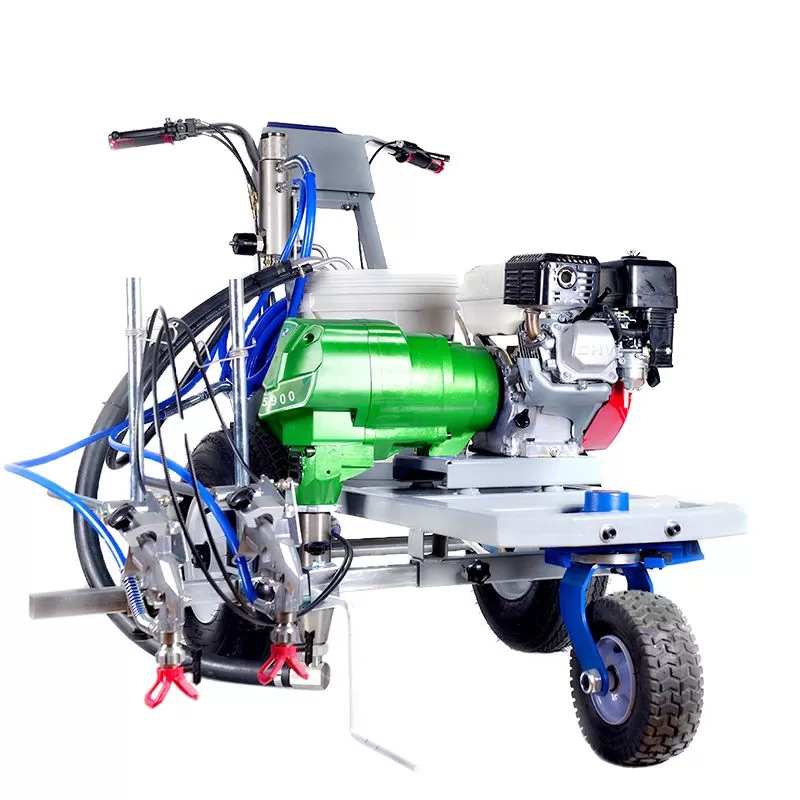
Whether you run heavy-duty gas stripers like the HVBAN series or standard hand-pushed units, your equipment relies entirely on the consistency of the paint running through the fluid section. This guide breaks down the science of tip-clog prevention so you can keep your crews rolling and maximize your daily linear footage.
The Real Cost of Tip Clogs in Commercial Line Striping
Contractors often treat tip blockages as minor field annoyances. In reality, they are severe margin killers that drain your bottom line over a commercial season.
Labor Downtime vs. Material Costs
Paint represents only 15% to 25% of the total cost of a line striping contract. Labor, insurance, fuel, and equipment amortisation make up the remaining balance. When a striper clogs, you are not just losing a few ounces of paint. You are paying a two-man or three-man crew to stand in an asphalt lot while someone clears a gun.
Clearing a stubborn blockage, re-priming the system, and purging the line burns roughly 10 to 15 minutes. If a machine clogs four times during an 8-hour shift, you lose an entire hour of billable production. Over a working month, that equals 20 to 30 lost hours per machine.
Inconsistent Line Quality and Overspray Issues
A partial tip clog is often worse than a total blowout. When solids lodge in the tip orifice, the spray pattern distorts instantly. You get heavy tails, fluttering edges, and heavy center ridges. In commercial retail parking lots, uneven edges violate project specifications.
Fixing those crooked lines requires black-out paint or grinding, followed by restriping. That doubles your material usage and destroys your project profit margins.
Why Does Parking Lot Line Striping Paint Clog Your Spray Tips?
Airless striping machines generate pressures between 1,500 and 3,300 PSI. At these velocities, fluid passes through an orifice as small as 0.017 to 0.021 inches. Any chemical or physical instability in the paint causes instant separation at this restriction point.
High-Solids Formulations: Durability vs. Flowability
Modern specifications demand high film builds that withstand snowplows, oil drips, and heavy turning traffic. To achieve this, manufacturers formulate high-solids traffic paints that contain up to 75% to 80% solids by weight. These solids include titanium dioxide, calcium carbonate, and specialized acrylic binders.
If the resin cannot fully encapsulate these dense mineral fillers, the pigment particles shear out of suspension under high pump pressures. The particles clump directly behind the spray tip diffuser, choking the fluid passage within seconds.
Premature Drying and "Skinning" in Fast-Dry Acrylics
Fast-dry waterborne traffic coatings use chemical cross-linking agents that react to ambient air and humidity. The moment the paint atomizes, volatile amines evaporate, triggering rapid curing. This process allows commercial lots to open to traffic in under 15 minutes.
However, that same mechanism works against you at the spray tip. When you release the gun trigger at the end of a stall line, a micro-droplet sits on the outside face of the tip. If that droplet skins over before you trigger the gun for the next line, the dried film pulls into the orifice on the next stroke, jamming the tip instantly.
Poor Pigment Dispersion and Inconsistent Viscosity
Economy-grade paints cut costs during the manufacturing grind phase. High-end industrial coatings run through horizontal bead mills to reduce pigment agglomerates to microscopic sizes. Budget paints skip this intensive milling, leaving large pigment aggregates in the drum.
These oversized particles pass easily through the pump inlet strainer, but they catch on the tight carbide edges of the spray tip. The result is recurring clogs, even when using brand-new tips.
Types of Heavy-Duty Parking Lot Line Striping Paint (And Their Clog Risk)
Selecting the right parking lot line striping paint requires balancing traffic volume requirements against the operational tendencies of each chemistry.
Fast-Dry Waterborne Acrylics: The Modern Standard
Fast-dry waterborne acrylic dominates commercial striping today. It satisfies strict municipal environmental codes, releases low odors, and cleans up easily with water and mild detergent.
- Durability: Excellent for shopping centers, commercial parking bays, and standard vehicle stalls.
- Clog Risk: Medium-High. Highly sensitive to direct sunlight, high heat, and dry crosswinds. Requires disciplined tip hygiene.
Solvent-Based / Acetone Traffic Paints: Cold-Weather Solutions
Solvent-borne alkyds and acetone-based paints remain popular in cold climates where temperatures dip below 50°F (10°C). They dry quickly through simple solvent evaporation rather than chemical cross-linking.
- Durability: Solid adhesion on aged, oxidized asphalt and smooth concrete surfaces.
- Clog Risk: Low-Medium. These paints resist premature tip skinning better than waterborne acrylics, but dried residue inside fluid hoses requires aromatic solvent flushes to remove.
2-Component Epoxies & Polyurethanes: Maximum Durability
Used primarily in distribution centers, loading docks, and high-frequency industrial facilities, two-component coatings deliver multi-year lifespans under continuous forklift and semi-truck abuse.
- Durability: Exceptional. Unmatched chemical and abrasion resistance.
- Clog Risk: Extreme. These reactive chemistries begin curing the moment part A meets part B. They require specialized plural-component spray systems with automated purging to prevent catastrophic pump and gun freeze-ups.
Key Features to Look for in Clog-Resistant Parking Lot Line Striping Paint (2026 Guide)
Before buying drums or pallets of paint, study the manufacturer's Technical Data Sheet (TDS). Look for these three critical indicators of fluid stability:
Hegman Grind Gauge Rating
The Hegman scale measures the fineness of pigment dispersion in liquid coatings. The scale runs from 0 (very coarse, 100 microns) to 8 (extremely fine, under 5 microns).
- Standard architectural paint rates around 3 to 4 Hegman.
- High-performance, clog-resistant parking lot line striping paint must rate at 4.5 Hegman or higher.
A higher grind ensures that every mineral particle passes cleanly through your airless tip without bridging the orifice.
Shear-Thinning Rheology
Quality traffic coatings exhibit thixotropic, or shear-thinning, behavior. Inside the bucket, the paint remains thick (80 to 90 Krebs Units) to prevent heavy pigments from settling into a hard pack at the bottom. However, when the fluid section of your HVBAN line striper pulls the material and subjects it to mechanical shear, the paint's viscosity drops immediately.
This drop allows the paint to atomize into a crisp, sharp pattern at lower working pressures. Lower pressure creates less turbulence and keeps the face of the spray tip clean.
Extended "Open-Tip" Time Technology
For 2026, progressive chemical manufacturers add humectant compounds and open-time extenders to their waterborne polymers. These additives slow down skin formation on exposed metal surfaces without extending the cure time of the painted line on the pavement. Look for paints advertising extended open-tip performance on their specification sheets.
Matching Your Paint with the Right Striping Equipment
Even the best parking lot line striping paint will fail if you run it through an improperly configured spray system. Match your fluid path to your paint chemistry.
Choosing the Correct Airless Spray Tip Size
Never spray heavy-duty, high-solids traffic paint through an undersized tip designed for residential stains or low-viscosity lacquers. Consult industry standards outlined by organizations like the Federal Highway Administration (FHWA) for recommended dry film thicknesses, and size your tips accordingly:
- .017 Inch Tip: Suitable only for low-viscosity solvent alkyds or thin, standard-solids waterborne paints. Prone to clogging with heavy-duty formulations.
- .019 Inch Tip: The industry workhorse. Balanced flow rate for standard 4-inch lines with high-solids fast-dry acrylics.
- .021 Inch Tip: Ideal for high-build coatings, heavy curb work, and textured asphalt where higher volume prevents tip pack-out.
Proper Mesh Filters: Manifold vs. Gun Filters
Filtration must occur in progressive stages. If you use a mesh that is too fine, the filter itself clogs, starving the pump and causing pressure drops that ruin your spray fan.
- Intake Rock Catcher: Coarse wire screen to catch drum debris and packaging shards.
- Pump Manifold Filter: Run a 50-mesh or 60-mesh filter here to trap pigment clusters before they travel down the whip hose.
- Gun Filter: When spraying heavy-bodied fast-dry traffic paint, remove the gun pencil filter entirely or use an open 30-mesh screen. Fine gun filters trap paint solids too close to the tip, causing internal pressure drops and rapid tip fouling.
Operating Pressure and Ambient Temperature Management
Dialing in your pressure requires balance. Too little pressure causes poor atomization and line tails. Too much pressure creates turbulent mist that bounces back onto the spray tip face, creating paint buildup that leads to a clog.
Set your pump pressure only as high as necessary to achieve a clean, rectangular line pattern with square edges. On hot, dry asphalt above 90°F (32°C), waterborne paint flashes off rapidly. Drop your gun slightly closer to the pavement to minimize atomization distance and prevent paint from drying mid-air.
Best Practices to Prevent Tip Clog On-Site
Equipping your crew with structured field habits eliminates 90% of routine tip clogs before they start.
Pre-Job: Power Agitation and Straining
Never rely on a hand stick to stir heavy traffic paint. High-solids paints settle during shipping and storage. Use a pneumatic or heavy cordless drill with an aggressive mixing paddle to shear the paint for at least two full minutes per 5-gallon pail.
Always pour the agitated paint through a commercial bucket strainer bag into your machine reservoir. This step catches dried paint rings from the lid, skin fragments, and factory debris that instantly block spray tips.
On-Site: The Two-Tip Rotation and Solvent Guards
Equip every operator with a reversible spray tip (RAC style). When a partial obstruction occurs, twist the tip 180 degrees, shoot a quick burst into a waste bucket, turn it forward, and keep striping.
Keep a small tip storage container filled with water (for latex) or mineral spirits (for solvent paints) strapped to your line striper. If the machine sits idle for more than two minutes while you snap chalk lines, place the spray tip directly into the liquid to keep the orifice wet.
Post-Job: The Triple-Flush Protocol
Residual paint inside the pump lower or high-pressure hose will peel off during your next job and travel straight to the tip. End every working day with a clean flushing cycle:
- Pump warm, soapy water through the system until the discharge runs clear.
- Flush with clean fresh water to remove soap residue.
- Pump pump-storage fluid through the circuit to lubricate packings, protect
the carbide seats, and prevent internal corrosion.
Contractor Selection Checklist for 2026
Before loading out for your next commercial parking lot contract, ensure your materials meet these benchmarks:
- Verified Grind Rating: Hegman 4.5+ confirmed on the Technical Data Sheet.
- Solids Content: 72% to 78% for commercial durability without unworkable viscosity.
- Tip Pairing: Premium reversible spray tips sized at .019 or .021 inches.
- Filtration Setup: 50-mesh manifold filter installed, pencil filter removed from line guns.
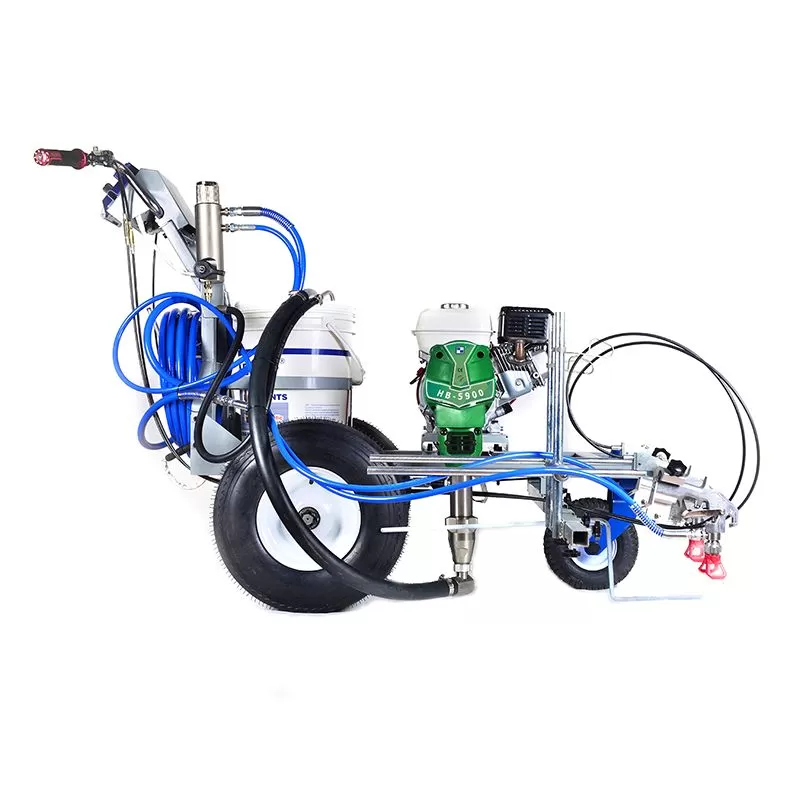
- Reliable Displacement Pump: Commercial-grade equipment like the HVBAN high-pressure line striping units designed to push heavy viscous coatings consistently.
High-durability pavement markings do not have to come at the expense of clogged equipment and wasted labor. By pairing high-grind, shear-thinning parking lot line striping paint with proper filtration and machine maintenance, you turn tough commercial specifications into smooth, profitable operations.
Are you updating your striping equipment for the 2026 season? Reach out to our technical sales representatives today to discuss wholesale equipment pricing, bulk coating compatibility, and replacement parts tailored to your operation.
Frequently Asked Questions
Q1: Why does my parking lot line striping paint clog the tip
immediately after changing to a new pail?
A1: This
issue usually happens because dried paint skins collected around the pail lid
fell into the fresh paint during opening, or because unmixed pigments settled at
the bottom of the container. Always power-mix your paint and pour it through an
external strainer mesh before pumping it through your machine.
Q2: Can I thin fast-dry waterborne traffic paint with water to stop
tip clogs?
A2: Thinning traffic paint is generally
not recommended and often violates regional VOC and municipal road
specifications. Adding more than 2% to 3% water breaks down the paint's acrylic
binder emulsion, leading to pigment washouts, extended drying times, and
premature wear. Instead of thinning, use a larger spray tip (such as upgrading
from .017 to .019) or adjust your pump pressure.
Q3: What is the ideal airless tip size for heavy-duty commercial
asphalt striping?
A3: A .019-inch tip with a 4-inch
fan width (such as a 219 or 319 line tip) serves as the standard for commercial
work using high-solids paints. For heavily textured asphalt or very thick
fast-dry coatings, stepping up to a .021-inch tip provides better fluid passage
and prevents clogs without sacrificing your line edges.
Q4: How does ambient temperature affect parking lot line striping
paint and tip performance?
A4: High ambient heat
and low humidity cause waterborne paints to flash-cure rapidly. Atomized mist
dries on the cold carbide face of your spray tip between trigger pulls, building
a crust that causes clogs. In high heat, keep tips submerged in liquid when
idle, work during cooler morning hours, and ensure your striper moves
consistently to keep paint flowing.
Q5: What should I do if my spray tip keeps clogging even though the
paint is strained?
A5: If strained paint continues
to clog your tip, inspect your equipment. Your manifold filter may be torn,
allowing dried flakes inside the high-pressure hose to travel down to the gun.
Alternatively, dried paint buildup inside the whip hose may be flaking off under
pressure. Flush the system thoroughly, replace old filters, and inspect the hose
lining.